Archive / Useful tips

RSS feed for this section

Advice from MinerTech engineers: inverters, batteries, solar panels, distribution boards, uninterrupted power.

dp-3602eada775876accb50ff08f8271513

How to connect our battery to a Deye inverter: cable, protocol and settings

The question we hear most often from owners of Deye inverters: “Will your battery really work with my inverter?” Yes, it will, if you connect the communication cable correctly and set a few parameters. Here we explain how to do it: which Deye inverter is suitable, which cable you need, what to set on the […]
porady-baipas-yak-pratsyuye

Automatic stabiliser bypass via an ATS: how to stop wasting energy

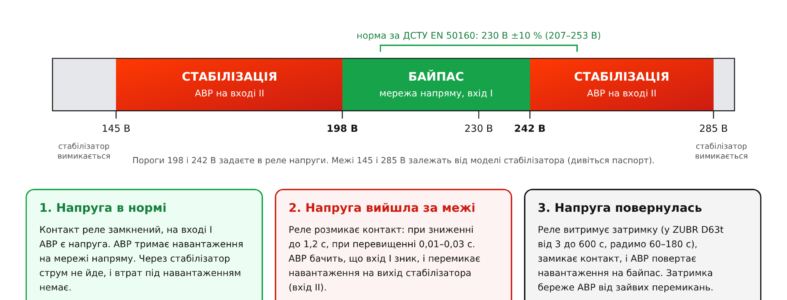
A voltage stabiliser works around the clock, even when the grid has exactly 230 V and there is nothing to correct. And every kilowatt-hour that passes through it is partly turned into heat. An acquaintance of ours put together simple automation: a voltage relay and an ATS route the house past the stabiliser by themselves […]

porady-stryng-paneley-mppt

How many solar panels to connect to an inverter: string calculation

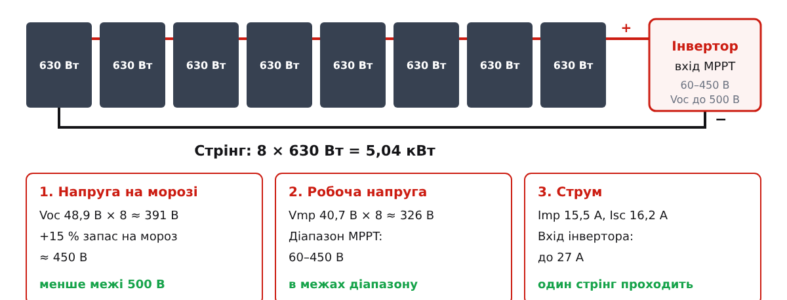
“How many solar panels can I connect to my inverter?” We hear this question every day. The answer depends not on the power you want, but on three figures: the panel voltage in frost, the inverter’s MPPT operating range and its input current. We will show the string calculation using the 630 W Tadiran TD630 […]

porady-etapy-zaryadu-cc-cv

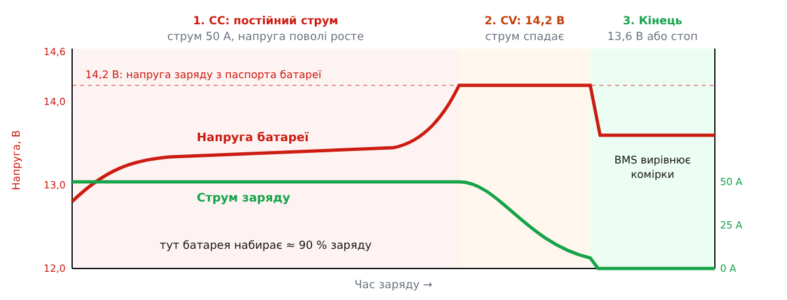
How to charge and store a LiFePO4 battery correctly: voltages, BMS, winter

A LiFePO4 battery withstands thousands of cycles, but only if it is charged and stored correctly. Most problems people bring to us are caused not by defects but by incorrect charge settings, frost or a battery that has stood discharged for months. Here we explain in simple terms which voltages to set, what the BMS […]

porady-try-invertory-3-fazy

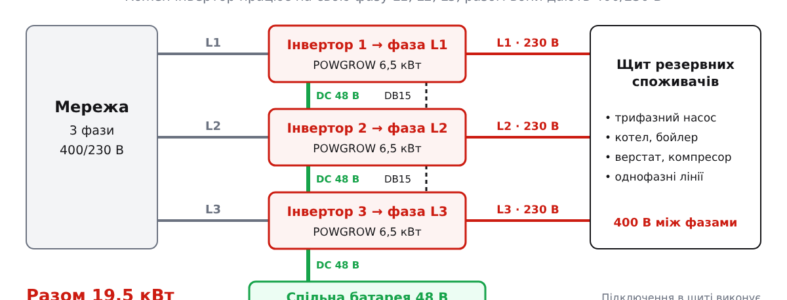
Three-phase backup power for homes and businesses: a kit of 3 inverters

Most houses and apartments get through power cuts with a single single-phase inverter. But if you have a three-phase well pump, a three-phase electric boiler, a machine tool or a compressor, one phase will not be enough: such loads simply will not start. They need three-phase backup power. Here we explain when it is really […]

porady-budynok-1-16-32-kvt-god

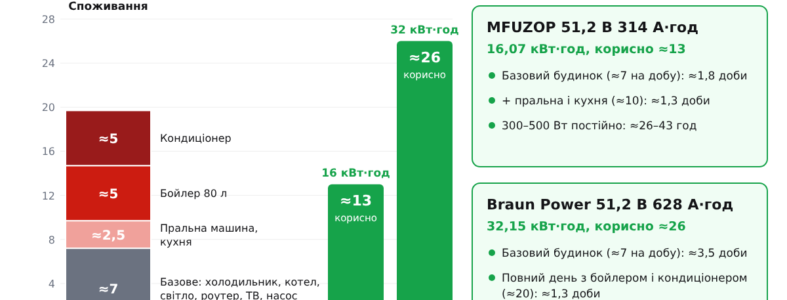
A 16–32 kWh home battery: when you need large capacity

For an apartment a battery of 2.5–8 kWh is usually enough. A private house lives differently: a well pump, a boiler, a water heater, a washing machine, and in summer an air conditioner. When power cuts last 8–16 hours or when solar panels are connected to the inverter, a home battery of 16–32 kWh becomes […]

porady-kvartyra-1-try-rivni

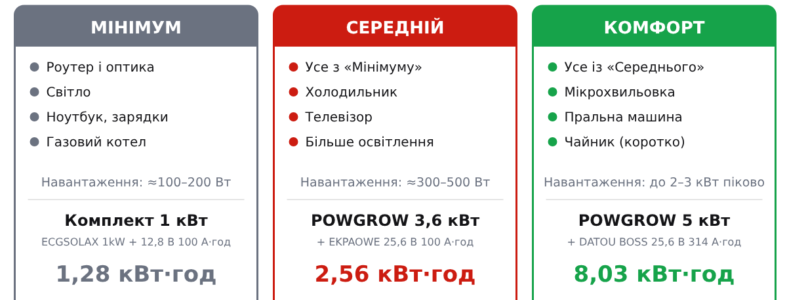
Backup power for an apartment: which battery + inverter kit to choose

Backup power for an apartment has long stopped being a luxury and become an ordinary part of everyday life. But when choosing, it is easy to go to one of two extremes: buy too little and sit without a fridge, or overpay for power you will never need. Here we explain how to choose a […]

porady-avtonomiya-1-tablytsya-godyn

How long will a battery + inverter kit last: calculating backup time

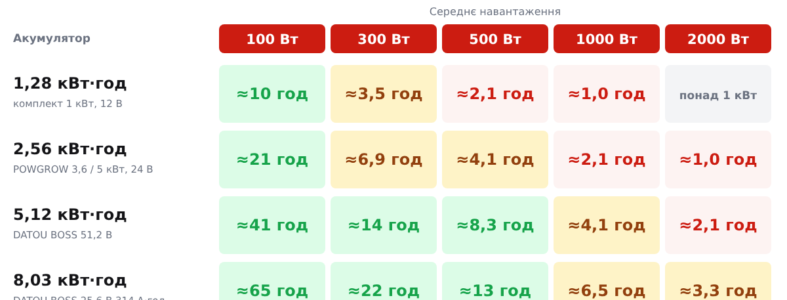
The first question people ask before buying backup power is: how many hours will a battery + inverter kit last during a power cut? The answer does not require complex software. All you need is the battery capacity, the approximate consumption of your appliances and one simple formula. Below we show how to calculate backup […]

porady-napruga-1-strum-3kvt

12, 24 or 48 volts: which system voltage to choose for backup power

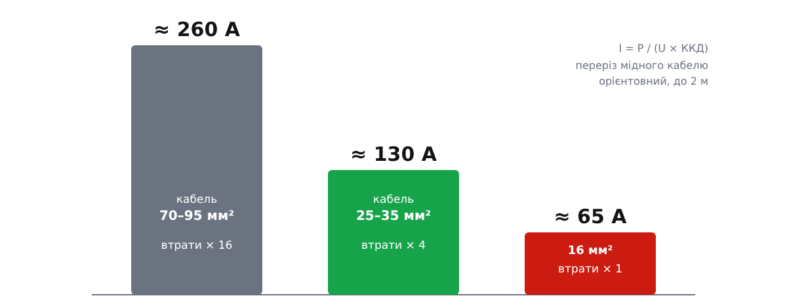
The first technical question we ask a customer before selecting a backup power system is: what power are we planning for? The answer determines the system voltage, that is, the voltage of the battery and inverter: 12, 24 or 48 volts. A mistake here means thick cables that heat up, a battery that cannot handle […]

porady-lifepo4-1-porivnyannya

LiFePO4 battery: what it is, how long it lasts and why it beats AGM/gel

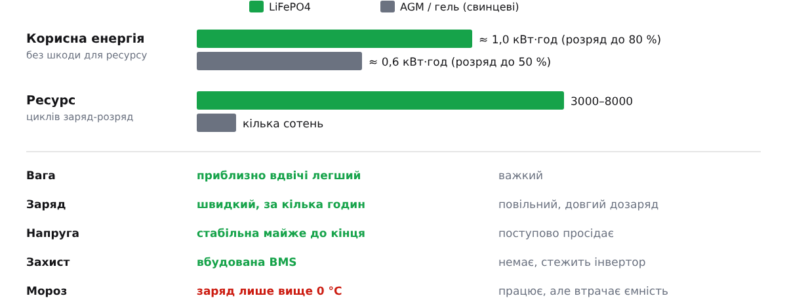
The LiFePO4 battery has become the standard for backup power in apartments and houses. When customers ask why we do not recommend lead-acid AGM or gel batteries, the answer is simple: a lithium iron phosphate battery delivers more energy, lasts many times longer and is not afraid of daily power cuts. Here we explain what […]