
LiFePO4 battery: what it is, how long it lasts and why it beats AGM/gel
The LiFePO4 battery has become the standard for backup power in apartments and houses. When customers ask why we do not recommend lead-acid AGM or gel batteries, the answer is simple: a lithium iron phosphate battery delivers more energy, lasts many times longer and is not afraid of daily power cuts. Here we explain what LiFePO4 is, what its service life depends on, why a BMS is needed and how to handle such a battery in winter.
What LiFePO4 is
LiFePO4 (lithium iron phosphate) is a type of lithium-ion battery. It differs from the batteries in phones and laptops in its cathode chemistry: iron phosphate is more stable, heats up less and is much more resistant to overcharging and mechanical damage. That is why LiFePO4 is used in stationary energy storage, solar stations and battery + inverter kits.
A single LiFePO4 cell has a nominal voltage of 3.2 V. That is why batteries are assembled from several cells in series:
- 4 cells (4S) = 12.8 V, for 12 V inverters;
- 8 cells (8S) = 25.6 V, for 24 V inverters;
- 16 cells (16S) = 51.2 V, for 48 V inverters.
Battery energy is calculated simply: voltage × capacity. For example, 25.6 V × 100 Ah = 2,560 Wh, that is 2.56 kWh.
Depth of discharge: how much energy you can use
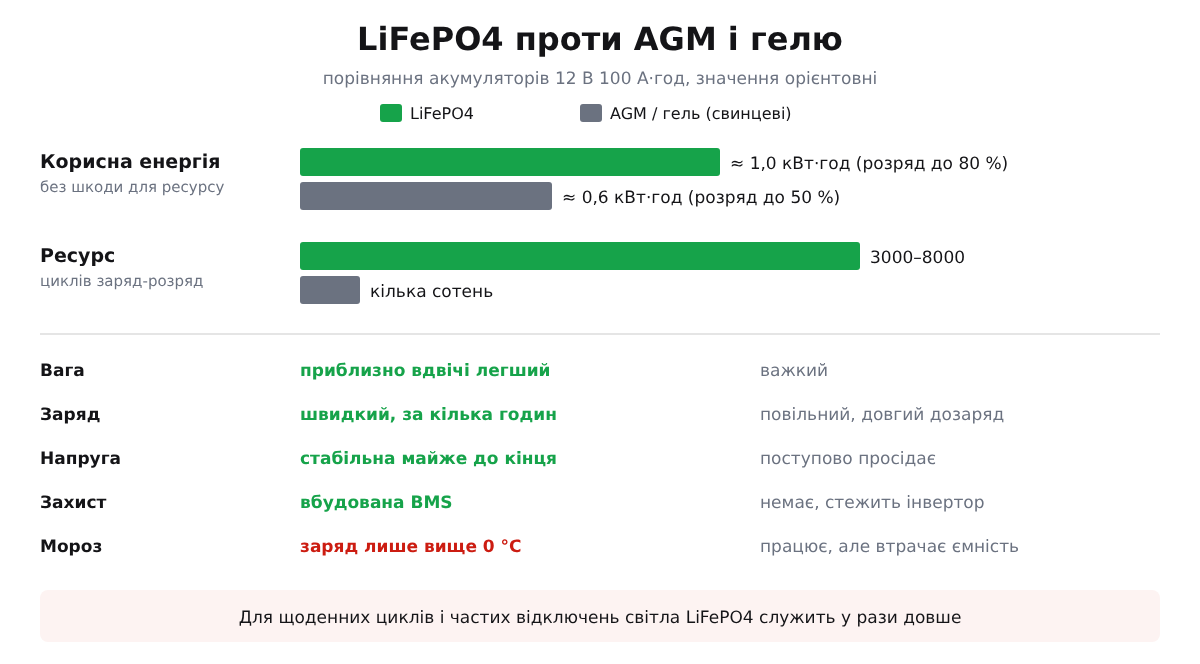
Lead-acid AGM and gel batteries do not like deep discharge. To make them last, they are discharged to about half. So from a 12 V 100 Ah battery rated at 1.2 kWh you actually get about 0.6 kWh, and the rest of the capacity sits “in reserve”.
LiFePO4 works comfortably at a depth of discharge of 80% or more. From a 12.8 V 100 Ah battery you can take about 1 kWh, and this does not shorten its life as sharply as with lead. As a result, one lithium battery replaces almost two lead-acid batteries of the same capacity in usable energy, and weighs about half as much.
Another advantage: LiFePO4 voltage hardly sags until the end of the discharge. The inverter does not shut down prematurely due to low voltage, and powerful appliances run steadily even at a low state of charge.
How long a LiFePO4 battery lasts
Battery life is measured in charge-discharge cycles. Lead-acid AGM and gel batteries with regular deep discharges usually withstand only a few hundred cycles. For LiFePO4 the norm is measured in thousands. Here is what the manufacturers of the batteries in our catalogue state:
| Battery | Energy | BMS / current | Rated service life |
|---|---|---|---|
| Foursun 12.8V 100Ah | 1.28 kWh | approx. 100 A | thousands of cycles |
| Humsienk Plus 12.8V 160Ah | 2.05 kWh | approx. 100 A | thousands of cycles |
| EKPAOWE 25.6V 100Ah | 2.56 kWh | approx. 100 A | thousands of cycles |
| DATOU BOSS 25.6V 314Ah | 8.03 kWh | 150 A, CAN/RS485 | ≥ 8,000 cycles to 80% capacity |
| DATOU BOSS 51.2V 100Ah | 5.12 kWh | 100 A, CAN/RS485 | over 3,000 cycles at 80% DoD |
| MFUZOP 51.2V 314Ah | 16.07 kWh | 200 A, CAN/RS485/RS232 | ≥ 8,000 cycles to 70% capacity |
Even 3,000 cycles with daily charging and discharging means more than 8 years of operation, and 8,000 cycles more than 20 years. It is important to understand that after the stated number of cycles the battery does not “die”, it simply retains 70–80% of its original capacity. During power cuts the battery is far from going through a full cycle every day, so the real service life is even longer.
BMS: the brain of a lithium battery
Every LiFePO4 battery has a built-in BMS (battery management system). It monitors the voltage of each cell and disconnects the battery in case of overcharge, deep discharge, short circuit and overheating. A lead-acid battery has no such protection: if the inverter is set up incorrectly, it is easy to “kill” it with deep discharge.
The BMS also determines how much power the battery can deliver continuously. A typical 12.8 V battery with a 100 A BMS gives about 1.2–1.3 kW, a 25.6 V 100 Ah one about 2.5 kW, the DATOU BOSS 25.6V 314Ah with a 150 A BMS up to 3.8 kW, and the MFUZOP 51.2V 314Ah about 8 kW. That is why the battery is always chosen together with the inverter.
Large batteries communicate with the inverter via CAN or RS485: the inverter sees the exact state of charge and charges the battery the way the BMS “asks”. Simpler models work without a communication cable, and then the user profile (USE) is selected in the inverter and the charging voltages from the battery datasheet are entered. We do this during connection.
LiFePO4 and frost
The main limitation of lithium batteries is related to cold. LiFePO4 can be discharged at sub-zero temperatures (for the DATOU BOSS 25.6V 314Ah and MFUZOP discharge is permitted from −20 °C), but it should be charged only at temperatures from 0 °C. Charging in frost damages the cells.
That is why the battery is placed indoors: in an apartment, a boiler room, an insulated hallway or a utility room. An unheated garage or balcony is not suitable for it in winter. Lead-acid batteries formally work in the cold but lose noticeable capacity, so a warm room is better for them too.
Safety
LiFePO4 is considered the safest lithium chemistry for the home: the battery does not emit gases while charging, does not need ventilation like flooded lead-acid batteries, and is not prone to catching fire. However, a high-capacity battery can deliver a very high current, so installation rules are mandatory.
Important
A DC breaker or fuse is fitted in the positive wire between the battery and the inverter, the power cable cross-section is chosen to suit the current, and the terminal bolts are tightened firmly, because a loose contact heats up. Do not connect in series batteries for which the manufacturer forbids it. The inverter is connected to the distribution board only by a qualified electrician.
Frequently asked questions
Can LiFePO4 replace an old AGM in the same system?
In most cases yes, if the inverter lets you set a lithium or user charging profile. The charging voltages must be set according to the new battery’s datasheet.
Should a LiFePO4 be kept fully charged?
For backup in case of outages, yes, and the inverter maintains the charge itself. A deeply discharged battery should not be left uncharged for long.
Can several batteries be connected together?
Identical batteries are connected in parallel for more capacity. DATOU BOSS and MFUZOP allow up to 15 units in parallel.
How long does a LiFePO4 battery take to charge?
It depends on the charging current. A 100 Ah battery at the recommended 50 A charges in about 2–2.5 hours; a lead-acid one of the same capacity takes much longer.
Expert opinion
We stopped offering lead-acid batteries for backup power long ago: after a few seasons of outages they lose noticeable capacity, while LiFePO4 in the same conditions works for years. The main thing is to match the battery to the inverter by voltage and BMS current and to place it in a warm room. For an apartment 25.6 V at 100–314 Ah is usually enough; for a house with a powerful inverter we recommend 51.2 V. We bring all batteries from Europe, give a 1-year warranty, and our team of electronics engineers has more than 1000 off-grid systems behind it. See ready-made pairs in the battery + inverter kits section.
We will help you choose a LiFePO4 battery for your inverter or design a system from scratch with turnkey installation in Dnipro and the region. Call us: 093 293 93 93, 099 054 40 38.