
How to charge and store a LiFePO4 battery correctly: voltages, BMS, winter
A LiFePO4 battery withstands thousands of cycles, but only if it is charged and stored correctly. Most problems people bring to us are caused not by defects but by incorrect charge settings, frost or a battery that has stood discharged for months. Here we explain in simple terms which voltages to set, what the BMS does, how to use a charger and how to keep a battery safe in winter.
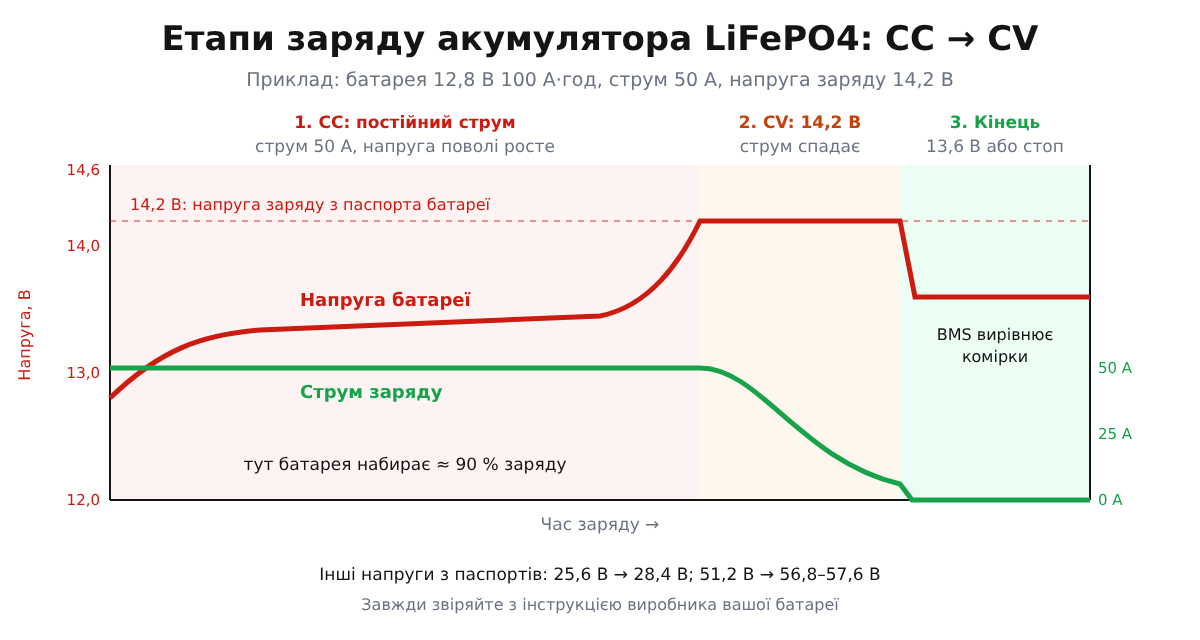
How LiFePO4 charges: CC and CV stages
A lithium iron phosphate battery charges in two main stages:
- CC, constant current. The charger or inverter supplies a set current, for example 50 A, and the battery voltage slowly rises. At this stage the battery takes most of its charge.
- CV, constant voltage. When the voltage reaches the set value (for example, 14.2 V for a 12-volt battery), the device holds it steady and the current gradually falls by itself. The battery is “topped up” to full charge, and the BMS balances the cells meanwhile.
- Completion. Charging stops or switches to float mode at a lower voltage.
Unlike lead-acid batteries, LiFePO4 does not need a long high-voltage “top-up charge” and does not like being kept at maximum all the time. That is why the float voltage is lower than the charge voltage.
LiFePO4 charging voltages: take them from the manufacturer’s manual
The main rule: always take the charge, float and cut-off voltages from your battery’s datasheet or manual. Below are the values from the descriptions of the batteries we sell. They are conservative and safe, but may differ for your model.
| Battery | Charge | Float | Cut-off in the inverter |
|---|---|---|---|
| 12.8 V (4S), e.g. Yulong 12.8 V 100 Ah | 14.2 V | 13.6 V | 12.0 V |
| 25.6 V (8S), e.g. EKPAOWE 25.6 V 100 Ah | 28.4 V | 27.2 V | 24.0 V |
| 51.2 V (16S), e.g. MFUZOP 51.2 V 314 Ah | 56.8–57.6 V | per datasheet | BMS protection 43.2 V |
The overcharge protection voltage (58.4 V for 51.2 V) is not a working charge voltage. It is the limit at which the BMS will disconnect the battery in an emergency. Setting the charge “right at the limit” is not worth it: you will not get noticeably more energy, and the cells will work under harsher conditions.
What the BMS does and what it will not do for you
A BMS (battery management system) sits inside every LiFePO4 battery we sell. It protects the cells against overcharge, deep discharge and short circuit, and in large batteries also against overheating and overcooling. Batteries with a communication port (CAN, RS485) send the state of charge to the inverter, and it then charges them according to the BMS commands.
But the BMS is protection, not a charger. If the battery is constantly driven to the point where the protection trips, its life is shortened. That is why the correct voltage and current must be set in the charger or inverter, and the BMS remains a safety net.
12 V 0–100 A charger: how to set it up
For high-capacity 12-volt batteries it is convenient to have a separate 12 V (3–16 V) 0–100 A charger. Both voltage and current are adjustable, so it works exactly according to the CC/CV scheme: first it limits the current, then it holds the set voltage.
- Voltage: according to the battery datasheet, for 12.8 V LiFePO4 usually 14.2–14.6 V. For the batteries in the table above we set 14.2 V.
- Current: no more than the manufacturer recommends. For example, for the Yulong 12.8 V 100 Ah it is up to 50 A, for the POWLAND 12.8 V 300 Ah up to 60 A. The full 100 A is usually too much for a typical 12-volt battery.
- Supply: charging at 100 A draws roughly 1.5 kW or more from the grid. If you charge from a generator, take its power reserve into account.
- After charging disconnect the device or reduce the voltage to the float level of 13.6 V.
Charging from the inverter and solar panels
A hybrid inverter has a built-in grid charger and an MPPT controller for solar panels, so charging happens automatically. It is important to set the battery type correctly:
- Battery with communication (CAN/RS485). You select the protocol, and the inverter takes the voltages and current from the BMS. This is the best option.
- Battery without communication. The user type (USE) is selected in the inverter, and the charge, float and cut-off voltages from the datasheet are entered manually.
- Limit the charging current to the value recommended for the battery, even if the inverter can deliver more. This applies especially to sun plus grid together.
The inverters section will help you choose an inverter for your battery, and ready-made pairs of pre-configured equipment are in the battery + inverter kits section.
Cell balancing
A battery consists of 3.2 V cells connected in series: 4 in 12.8 V, 8 in 25.6 V, 16 in 51.2 V. Over time their charge drifts apart slightly. The BMS balances the cells mostly at the end of charging, in the CV stage. Passive balancing (as in the MFUZOP) dumps the excess as heat, while active balancing (as in the Braun Power, at up to 2 A) moves energy between cells and works faster.
A practical tip: if the system runs in partial cycles for months, let the battery charge fully at the datasheet voltage once every few weeks. That gives the BMS time to balance the cells, and the state-of-charge indicator reads more accurately.
How to store a LiFePO4 battery, including in winter
- State of charge for storage: about 50–60%. Do not store the battery fully discharged: self-discharge and BMS consumption can bring it below the protection threshold.
- Disconnect the load and the inverter. Even without a load the inverter consumes energy: for example, the POWGROW SMS-6.5KP uses up to 50 W, that is more than 1 kWh a day.
- Check every 2–3 months and recharge to 50–60% if needed.
- Frost: LiFePO4 can be discharged in the cold (the MFUZOP from −20 °C), but charged only at temperatures above 0 °C. First bring a battery from a cold garage into the warm and let it warm up for a few hours.
- Location: a dry room, out of direct sunlight and away from heaters.
Important
Do not charge LiFePO4 in frost, do not connect batteries of different capacity or different state of charge, and do not exceed the recommended current. Connecting the battery to the inverter and the board, the breakers and cable cross-sections must be handled by a qualified electrician.
Frequently asked questions
Can LiFePO4 be charged with an ordinary car charger?
Only if it has a LiFePO4 mode or lets you set the voltage according to the datasheet. Desulphation and “recovery” modes for lead-acid batteries harm a lithium battery.
Should the battery be fully discharged before charging?
No. LiFePO4 has no “memory effect”; partial cycles are normal for it.
The battery will not charge after winter. What should I do?
Check the temperature: in frost the BMS blocks charging. If the battery is warm but will not charge, it may be deeply discharged and the BMS has gone into protection. Call us and we will tell you what to do.
Is it harmful to keep the battery at 100% all the time?
For backup it is acceptable, but it is better when the float voltage is lower than the charge voltage. That is exactly why the settings have a separate float value.
Expert opinion
Charging LiFePO4 correctly comes down to three things: voltage and current from the battery datasheet, charging only in the warm, and storage at half charge. This chemistry needs nothing else special, and that is why we recommend it for backup power and photovoltaics. We bring all our batteries from Europe, give a 1-year warranty and set up the inverter for the specific battery during installation. See the full range in the batteries section.
Unsure about the settings of your inverter or charger? Call us: 093 293 93 93 or 099 054 40 38. We will advise you and, if needed, carry out turnkey installation in Dnipro and the region.