
Backup power for an apartment: which battery + inverter kit to choose
Backup power for an apartment has long stopped being a luxury and become an ordinary part of everyday life. But when choosing, it is easy to go to one of two extremes: buy too little and sit without a fridge, or overpay for power you will never need. Here we explain how to choose a battery + inverter kit for power cuts using three clear scenarios, and how to connect it properly to the apartment distribution board.
Start with a list of appliances, not with the inverter power
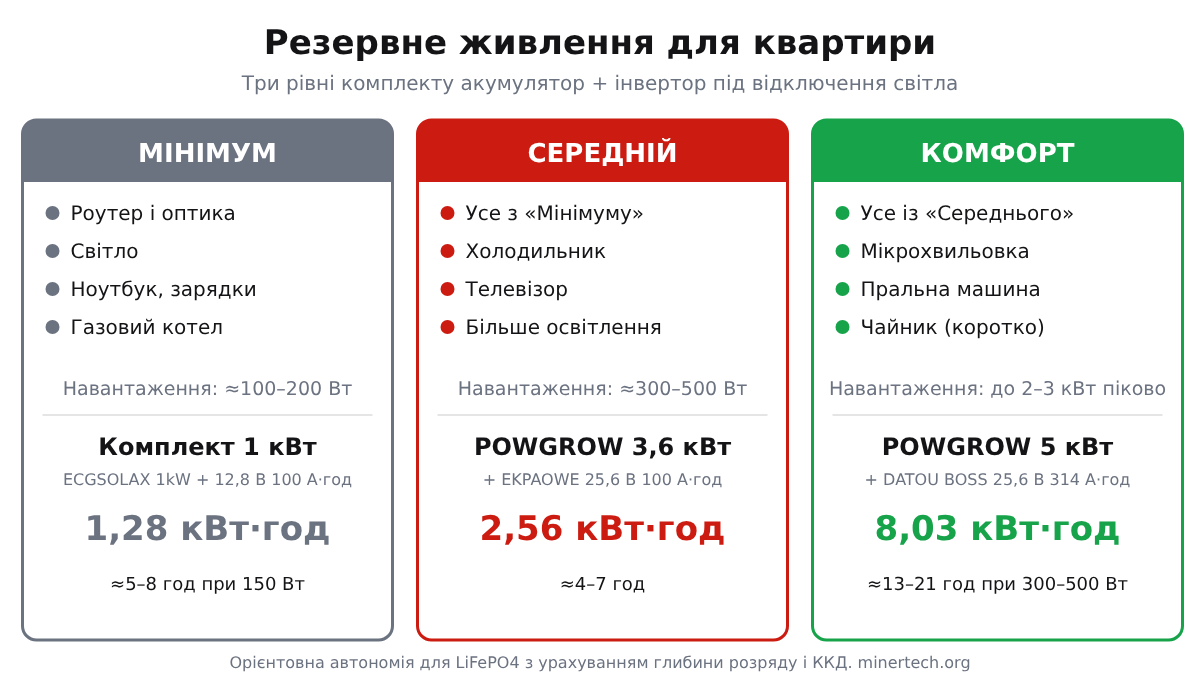
Take a sheet of paper and write down what has to work when the power goes out. For each appliance two things matter: how much it consumes on average (this determines how many hours the battery will last) and what power it draws at start-up (this determines the inverter power). We covered the detailed backup time calculation with the formula separately; here we focus on choosing the kit. Almost all apartment requests fit into three levels.
Minimum: router, lighting and boiler
The goal: stay connected, have light, work from a laptop and keep the gas boiler from stopping in winter. The total load is 100–200 W.
For this the 1 kW kit: ECGSOLAX 12V 1kW inverter + 12.8 V 100 Ah battery is enough. The inverter delivers a pure 230 V sine wave, charges the battery from the grid by itself and switches the load to the battery in about 10 ms. The usable energy reserve is about 1.04 kWh: at 300 W that is roughly 3.5 hours, and noticeably more with the load of a router, lighting and boiler. The inverter weighs about 3 kg and easily fits in a hallway or cupboard. Later you can connect up to 600 W of solar panels to it if you have a balcony or a country house.
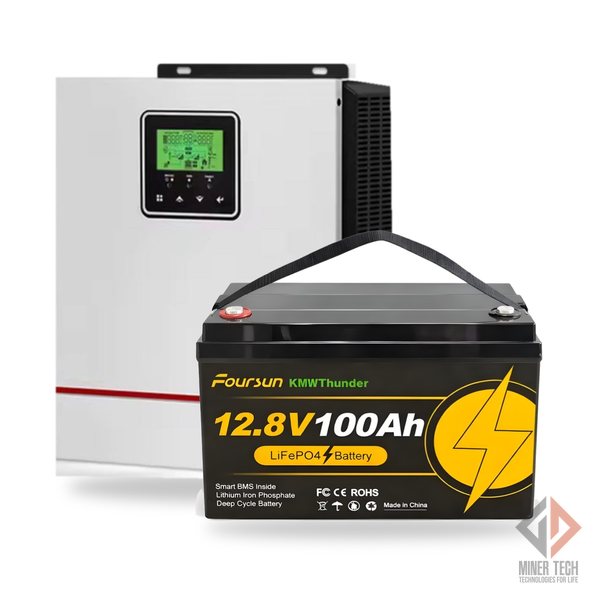
Limitation: sustained output from the battery is about 1.2 kW. A kettle, microwave or iron should not be powered from this kit.
Medium level: fridge, boiler and TV
This is the most popular scenario: the apartment lives an almost normal evening life. The fridge, gas boiler, TV, router, lighting and laptops are running. The average load is 300–500 W, but starting the fridge compressor briefly requires many times more.
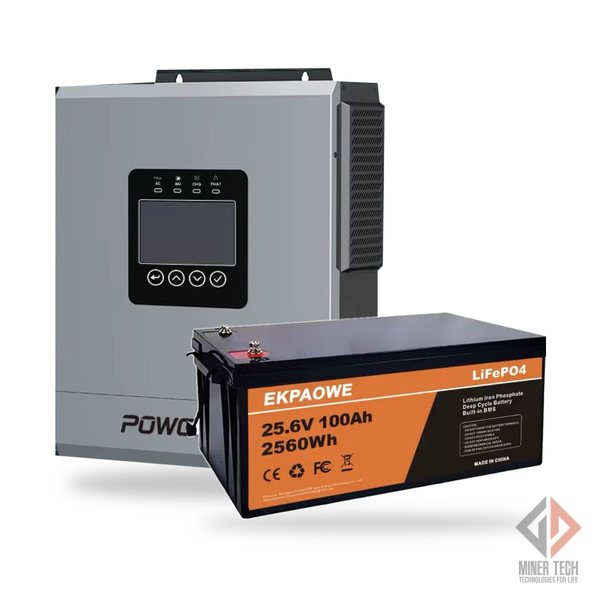
Here the optimal choice is the POWGROW 3.6kW 24V + EKPAOWE 25.6V 100Ah kit. The 3.6 kW inverter with a peak power of 7.2 kVA easily withstands starting currents, and the 2.56 kWh battery gives roughly 7 hours at 300 W and 4 hours at 500 W. There is WiFi monitoring, so the battery charge and current consumption are visible on your phone.
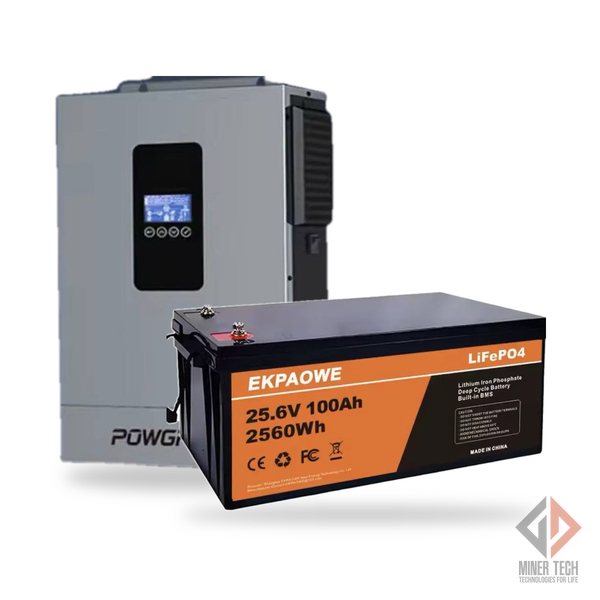
To be honest about the limitations: the battery BMS is rated at roughly 100 A, which means about 2.3 kW of sustained load from the battery. The inverter delivers its full 3.6 kW when the grid or sun is available.
Comfort: plus a microwave and a washing machine
If you want not to notice the outages at all, the list grows to include a microwave (about 1–1.3 kW from the grid side), a washing machine (up to 2 kW while heating water) and briefly a kettle. Here both the inverter power and the current the battery can deliver matter.
We recommend the POWGROW SMS-5kW 24V + DATOU BOSS 25.6V 314Ah kit of 8.03 kWh. The inverter is 5 kW with a 10 kVA peak, and the battery’s 150 A BMS gives a sustained output of up to ≈3.8 kW. The usable reserve is about 6.5 kWh: roughly 21 hours at 300 W and 13 hours at 500 W, that is the whole evening and night. The inverter and battery exchange data over a CAN/RS485 cable, so the inverter knows the state of charge precisely.
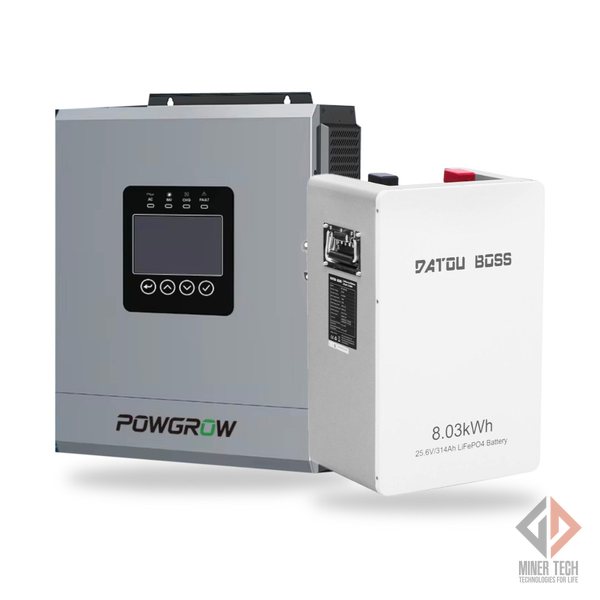
If your budget is limited, there is the POWGROW SMS-5kW + EKPAOWE 25.6V 100Ah kit: the same inverter, but with a 2.56 kWh battery and an output of about 2.3 kW. It is a convenient choice to “grow into” and later increase the capacity without changing the inverter. The POWGROW SMS-5kW has two outputs: secondary loads can be switched off automatically to save charge for the fridge and boiler.
| Level | Kit | Capacity | Battery output | Solar panels |
|---|---|---|---|---|
| Minimum | ECGSOLAX 1 kW, 12 V | 1.28 kWh | ≈1.2 kW | up to 600 W |
| Medium | POWGROW 3.6 kW, 24 V | 2.56 kWh | ≈2.3 kW | up to 5,000 W |
| Comfort | POWGROW 5 kW, 24 V | 8.03 kWh | ≈3.8 kW | MPPT 60–450 V |
Installation and connection to the apartment distribution board
The most common mistake is to put the inverter in a corner, plug it into a socket and run extension leads around the apartment. This is inconvenient and dangerous. The correct scheme looks like this:
- The inverter input (AC IN) is connected through a separate circuit breaker from the main busbar of the board. While there is power, the inverter passes the grid through to the output and charges the battery.
- The inverter output (AC OUT) powers a separate backup group: the fridge socket, the boiler, the router and part of the lighting.
- A 1-0-2 changeover switch lets you power the backup group directly from the grid while the inverter is being serviced and prevents the inverter output from being connected to the grid.
- The battery is connected with short power cables of the appropriate cross-section, with a fuse next to the battery. The cables and accessories you need are in the “Miscellaneous. Components” section.
We described in detail how to lay out the groups and where to leave room for the backup busbar in the article on the optimal distribution board for an apartment. If the apartment’s allocated power is small and the inverter charges the battery with a high current, a priority relay will be useful.
Important
Work in the distribution board is done only by a qualified electrician. The neutral of the backup group is taken from the inverter output and is not combined with the N busbars of the main board after the RCD, and the N and PE scheme is checked against the manual of the specific inverter. A mistake here can trip the protection or damage the equipment.
Where to place the kit in an apartment
The best place is a dry room at room temperature, close to the board, such as a hallway, storeroom or ventilated wardrobe. LiFePO4 batteries do not emit gases and need no maintenance, but they must not be charged in frost, so an unheated glazed balcony is not suitable in winter. Under load the inverter runs with a fan, so a bedroom is not the best choice. The DATOU BOSS 25.6V 314Ah weighs up to 61 kg and is fixed to the wall with the bracket supplied, so the wall must be load-bearing.
Frequently asked questions
Which kit should I choose if the apartment has an electric stove?
Powering an electric stove from a battery makes no sense: in an hour it will use up most of even a large battery. Leave the stove on the grid, and for cooking during outages use a microwave at the “Comfort” level.
Can I start with the minimum and expand later?
Yes, if you choose an inverter with headroom from the start. The POWGROW 3.6 and 5 kW run on 24 V, and later you can add a second battery or replace it with a larger one.
Is the kit suitable for a gas boiler?
Yes, all three kits deliver a pure sine wave, which is safe for the boiler electronics and the circulation pump.
Are solar panels needed in an apartment?
Not necessarily. The kit works perfectly well from the grid alone. But hybrid inverters already have a built-in MPPT controller, so you can connect solar panels on the balcony at any time.
Expert opinion
For most apartments the sweet spot is a 3.6–5 kW inverter on 24 V. It will handle the fridge, boiler and appliances with headroom for starting currents, and the battery capacity can be chosen to fit your outage schedule. That is why we advise not to economise on the inverter, but to be flexible with capacity: start with 2.56 kWh and move to 8 kWh if outages get longer. We bring all equipment from Europe, give a 1-year warranty, and our team of electronics engineers has more than 1000 off-grid systems behind it.
Call us, and we will select a battery + inverter kit for your apartment and carry out turnkey installation in Dnipro and the region: 093 293 93 93, 099 054 40 38.