
How long will a battery + inverter kit last: calculating backup time
The first question people ask before buying backup power is: how many hours will a battery + inverter kit last during a power cut? The answer does not require complex software. All you need is the battery capacity, the approximate consumption of your appliances and one simple formula. Below we show how to calculate backup time yourself and give a ready-made table for the most popular LiFePO4 capacities.
Backup time formula: capacity, depth of discharge, efficiency and load
Battery run time is calculated like this:
Hours = capacity (kWh) × usable depth of discharge × efficiency ÷ load (kW)
- Capacity is stated on the battery: 12.8 V × 100 Ah = 1.28 kWh; 25.6 V × 100 Ah = 2.56 kWh; 51.2 V × 100 Ah = 5.12 kWh.
- Usable depth of discharge. A LiFePO4 battery can be discharged deeply, but the inverter is usually set to cut off with a small reserve so that the BMS does not trip at zero and the battery lives longer. For the calculation we take 90%.
- Efficiency. The inverter converts the battery’s direct current into 230 V with losses. Manufacturers state up to 93–94% from the battery, but at low loads it is lower. Conservatively we take 90%.
- Load is the average power of all appliances running at the same time, in kilowatts (300 W = 0.3 kW).
Together the factor is 0.9 × 0.9 ≈ 0.81. That is, out of every kilowatt-hour in the battery, about 0.8 kWh actually reaches the socket. This is exactly how we calculate backup time in the kit descriptions on the site.
How much typical household appliances consume
The main mistake is adding up the rated power of all appliances. A fridge or boiler works in cycles, so what matters is the average power over an hour, not the maximum. Approximate values:
| Appliance | Power while running | Average for calculation |
|---|---|---|
| Router, ONU, camera | 10–20 W | 15 W |
| LED lighting (3–5 lamps) | 30–50 W | 40 W |
| Laptop | 45–90 W | 60 W |
| TV | 60–150 W | 100 W |
| Fridge | 100–200 W (compressor), several times more at start-up | 60–80 W |
| Gas boiler with circulation pump | 80–150 W | 100 W |
| Heating circulation pump | 40–100 W | 60 W |
| Well pump | 750–1100 W, high starting current | calculate by running time |
The exact value for a specific appliance is easy to check with a plug-in household wattmeter or in the inverter app: most hybrid models show the current load in real time.
Backup time table for 1.28 / 2.56 / 5.12 / 8.03 kWh
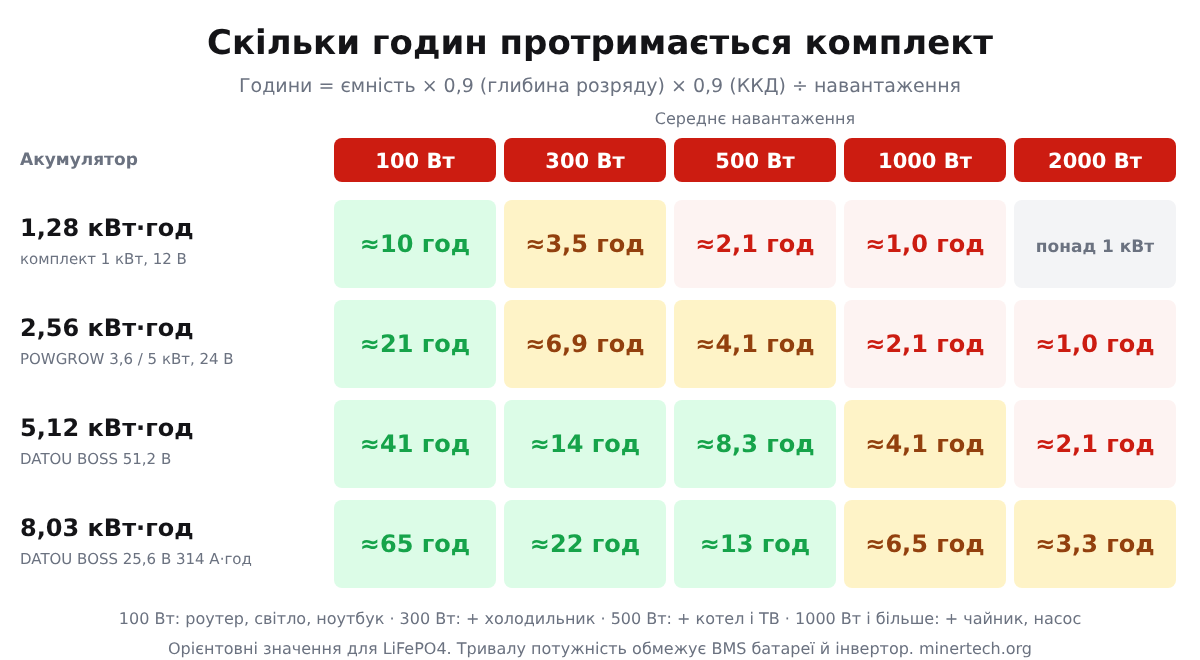
We calculated run time using the formula above for the four most common LiFePO4 battery capacities and five load levels.
| Battery capacity | Usable energy | 300 W | 500 W | 1000 W | 2000 W |
|---|---|---|---|---|---|
| 1.28 kWh (12 V) | ≈1.04 kWh | ≈3.5 h | ≈2 h | ≈1 h | not for this load |
| 2.56 kWh (24 V) | ≈2.07 kWh | ≈7 h | ≈4 h | ≈2 h | ≈1 h |
| 5.12 kWh (48 V) | ≈4.15 kWh | ≈14 h | ≈8 h | ≈4 h | ≈2 h |
| 8.03 kWh (24 V) | ≈6.5 kWh | ≈21 h | ≈13 h | ≈6.5 h | ≈3 h |
Example calculation for an apartment
During an evening power cut the router (15 W), lighting (40 W), TV (100 W), laptop (60 W), fridge (70 W on average) and gas boiler (100 W) are running. That is about 385 W in total, or 0.385 kW.
- With a 2.56 kWh battery: 2.56 × 0.9 × 0.9 ÷ 0.385 ≈ 5.4 hours.
- With an 8.03 kWh battery: 8.03 × 0.81 ÷ 0.385 ≈ 17 hours.
If the outage schedule is up to 4 hours, the 2.56 kWh POWGROW 3.6kW + EKPAOWE 25.6V 100Ah kit will be enough. If there is no power all evening and night, it is better to take the 8.03 kWh POWGROW SMS-5kW + DATOU BOSS 25.6V 314Ah kit straight away. For a minimal set (router, lighting, laptop, boiler) the compact 1 kW kit with a 12V 100Ah battery will do.
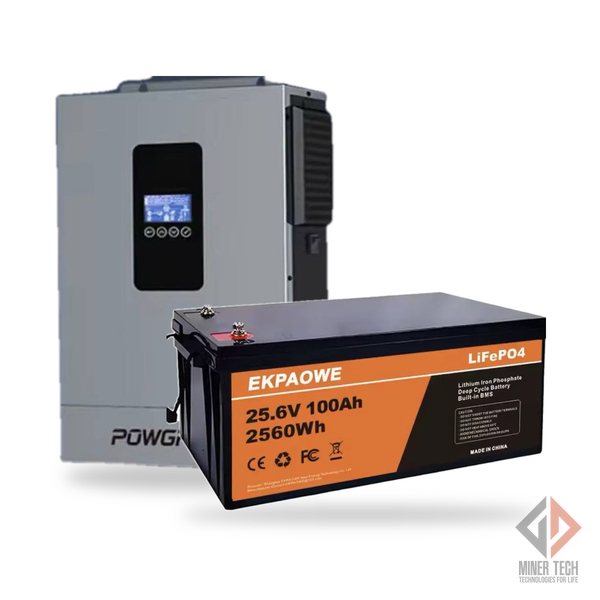 Kit POWGROW 3.6kW + EKPAOWE 25.6V 100AhView the kit →
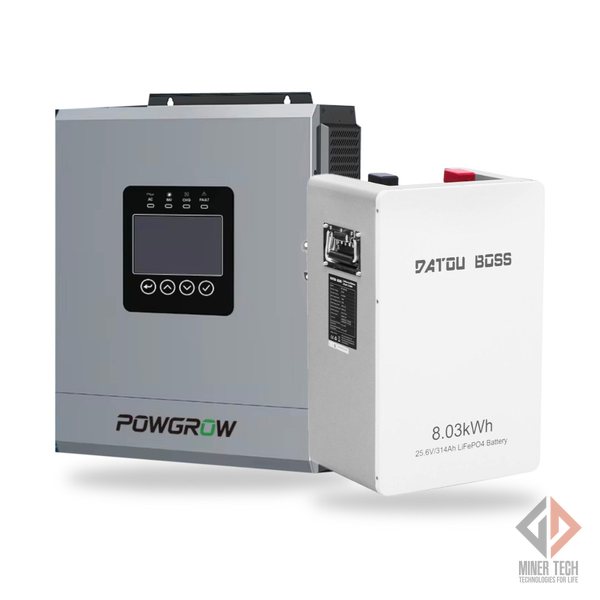 Kit POWGROW SMS-5kW + DATOU BOSS 8.03 kWhView the kit →
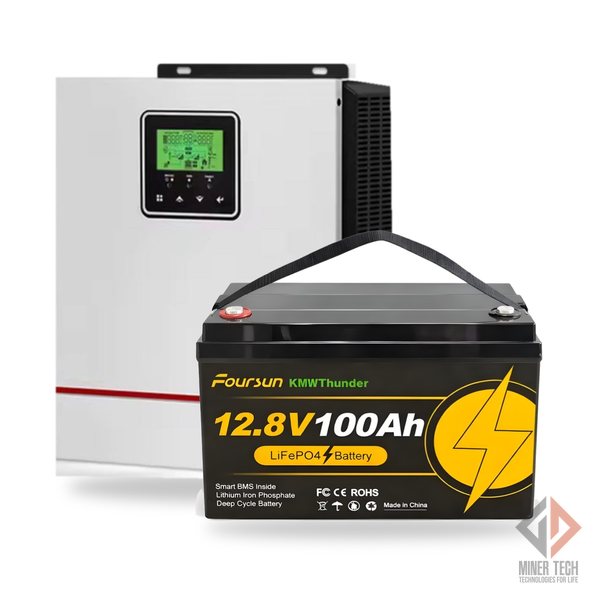 1 kW kit: 12 V inverter + 12.8 V 100 Ah batteryView the kit →
What reduces real backup time
- The inverter’s own consumption. A switched-on inverter uses energy even with no load: for hybrid models this is usually tens of watts. At low loads (100 W or less) this noticeably shortens the time, so add 30–50 W to the calculation.
- Cold. LiFePO4 capacity drops temporarily in frost, and such batteries must not be charged below 0 °C. Place the battery in a warm room.
- BMS limits. A 25.6 V 100 Ah battery with a 100 A BMS delivers only about 2.3–2.5 kW continuously, even if the inverter is rated for 5 kW. That is why not only capacity matters, but also the battery current.
- Powerful appliances. A kettle, water heater or electric stove “eats” as much in half an hour as a router does in several days. It is better to switch them on only when the grid is available, or to put them on a separate inverter output.
Important
Backup time depends on the average load, while the ability to start an appliance depends on the peak. A fridge or pump draws several times more for a second at start-up. That is why inverter power is chosen by starting currents, and battery capacity by the number of hours without power.
How to increase a kit’s backup time
There are three ways. First: add another identical battery in parallel. For example, the 5.12 kWh DATOU BOSS 51.2V 100Ah allows up to 15 batteries in parallel. Second: connect solar panels to the hybrid inverter so that during the day the battery charges from the sun, not only from the grid. Third: split the load and power from the backup only what you really need during an outage. All ready-made options are collected in the battery + inverter kits section.
Frequently asked questions
Why does the table not use 100% of the battery capacity?
Because the inverter has losses and the battery is not discharged to zero. An honest calculation with a factor of about 0.8 matches what customers see in practice.
How long will a kit last for a boiler and a router?
About 115 W together. A 1.28 kWh battery will give roughly 6–7 hours allowing for the inverter’s own consumption, and 2.56 kWh twice as long.
Can I calculate in amp-hours?
You can, but it is easy to make a mistake: 100 Ah at 12.8 V and at 51.2 V differ fourfold. Convert everything to kWh by multiplying by the voltage.
How long does the battery take to recharge after an outage?
It depends on the inverter’s charging current and the battery’s recommended current. For 100 Ah batteries with a recommended current of up to 50 A it is roughly 2–2.5 hours from the grid.
Expert opinion
In practice we advise taking capacity with a margin of about 30% above the calculation. Outage schedules change, boiler consumption rises in winter, and new appliances are added over time. The difference between “just enough” and “comfortably enough” is usually one capacity step, and that step almost always pays for itself. We bring all equipment from Europe, give a 1-year warranty and have already delivered more than 1000 off-grid systems.
Don’t want to calculate it yourself? Call us, and an electronics engineer will select a kit for your appliances and outage schedule, and our team will carry out turnkey installation in Dnipro and the region: 093 293 93 93, 099 054 40 38.