
How to choose an inverter for your home: power, hybrid or not, 24 or 48 V
The inverter is the heart of any backup power system: it is what turns battery energy into the familiar 230 V and decides whether your home will get through a power cut without you noticing. A wrong choice is costly: an undersized inverter shuts down from overload, an oversized one makes you overpay for power the battery cannot deliver. Here we explain how to choose an inverter for an apartment or house by answering three main questions: what power, whether you need a hybrid inverter and which battery voltage to choose, 12, 24 or 48 V.
Step 1. Work out what will run at the same time
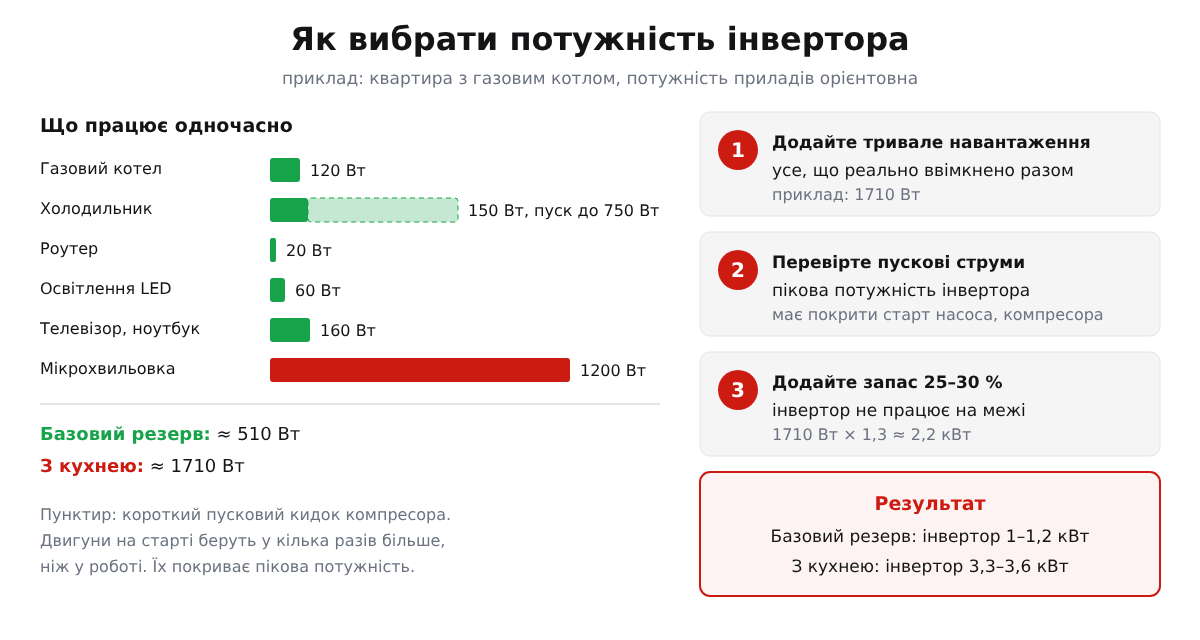
Start not with the catalogue but with a list of appliances that must run during a power cut. What matters is not the total of all the equipment in the home, but what is actually switched on together. A boiler, fridge, router, lighting and TV together usually draw 400–600 W. Add a microwave or electric kettle, and the load immediately rises to 1.7–2.5 kW.
Look for an appliance’s power on its label or in its manual. As a guide: a gas boiler with a pump 80–150 W, a fridge 100–200 W when running, LED lighting for an apartment 50–100 W, a microwave 1–1.5 kW, a kettle about 2 kW.
Step 2. Take starting currents into account
Appliances with an electric motor (fridge, well pump, air conditioner, washing machine, compressor) draw several times more at start-up than when running, usually 3–5 times more. This surge lasts a fraction of a second or a few seconds, and it is what the inverter’s peak power must cover.
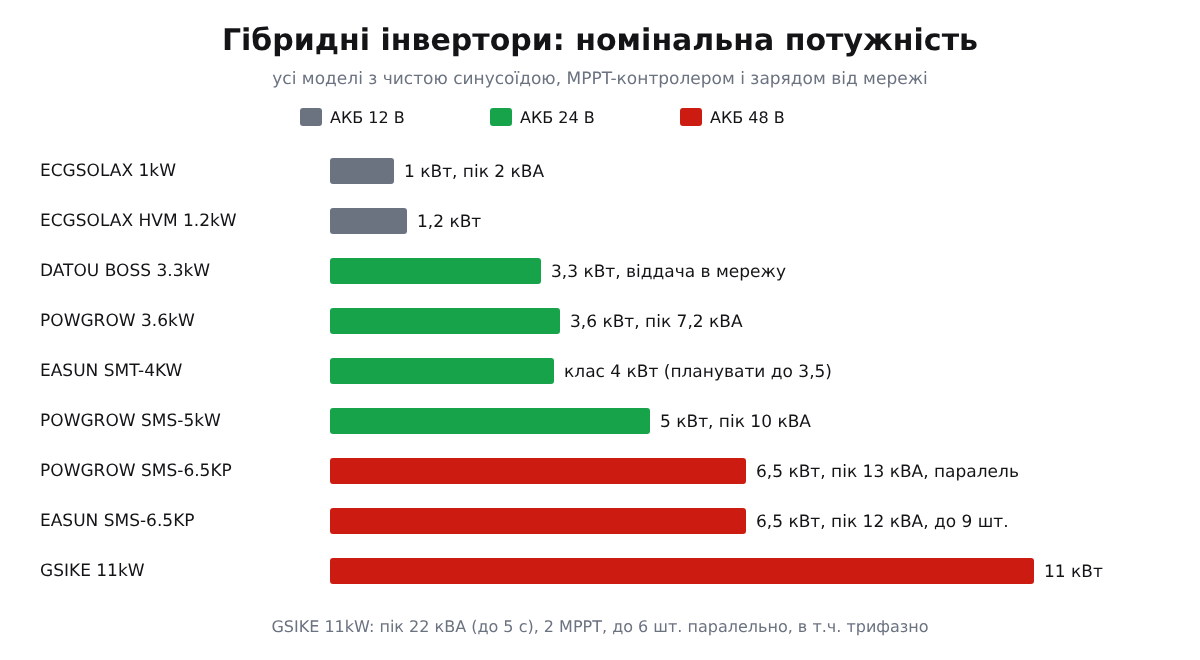
So look at two figures in the specifications: rated power (how much the inverter delivers continuously) and peak power (how much it withstands briefly). For example, the POWGROW 3.6kW has 3,600 W rated and 7.2 kVA peak, the POWGROW SMS-5kW has 5 kW and 10 kVA, and the GSIKE 11kW holds 22 kVA for up to 5 seconds. The compact ECGSOLAX 12V 1kW gives a peak of 2,000 VA for about 5 seconds: enough to start a fridge, but not a well pump.
The last step is simple: add a 25–30% margin to the total load. An inverter that constantly works at its limit heats up and shuts down from overload more often.
Hybrid inverter or a regular one
A simple inverter only converts the battery’s direct current into alternating current. An inverter with a charger also charges the battery from the grid and automatically switches the load over when the power goes out. A hybrid inverter adds an MPPT solar panel controller to this, so it can take energy from three sources at once: the grid, the battery and the sun.
For the home we recommend hybrid models, and all the inverters in our catalogue are hybrid. The price difference from “simple” ones is small, and you get:
- automatic transfer to the battery in about 10 ms, so the computer and router do not restart;
- a pure sine wave, safe for gas boilers and circulation pumps;
- the option to add solar panels later without replacing equipment;
- operation with a generator: the inverter charges the battery and smooths its voltage.
Pay particular attention to communication with the battery BMS (CAN or RS485 ports). Then the inverter “sees” the real state of charge of the lithium battery and charges it correctly. The simplest 12-volt models have no such port, and the battery is set up manually through a user profile.
12, 24 or 48 V: battery voltage
Each inverter is designed for a specific battery voltage, and it cannot be changed later. The rule is simple: the higher the power, the higher the voltage. At the same power, the current in the cables at 24 V is half that at 12 V, and at 48 V it is halved again. Lower current means thinner cables, less heating and lower losses. More on this in a separate guide to choosing the system voltage.
- 12 V suits up to 1–1.2 kW: boiler, internet, lighting.
- 24 V is optimal for an apartment and a small house, 3–5 kW.
- 48 V for a house with pumps, a water heater, a kitchen and a solar station, 6.5–11 kW and more.
Comparison of inverters from the catalogue
| Model | Power / peak | Battery | Panels | What for |
|---|---|---|---|---|
| ECGSOLAX HVM 1.2kW, ECGSOLAX 1kW | 1–1.2 kW / up to 2 kVA | 12 V | up to 600–800 W | boiler, router, lighting, country house |
| DATOU BOSS 3.3kW | 3.3 kW | 24 V | up to 5,000 W | apartment, feeding into the grid |
| POWGROW 3.6kW | 3.6 kW / 7.2 kVA | 24 V | up to 5,000 W | apartment, small house |
| EASUN SMT-4KW | 4 kW class | 24 V | MPPT 60–500 V | apartment, country house |
| POWGROW SMS-5kW | 5 kW / 10 kVA | 24 V | MPPT 60–450 V | house, office, two outputs |
| POWGROW SMS-6.5KP, EASUN SMS-6.5KP | 6.5 kW / 12–13 kVA | 48 V | up to 9,000 W | private house, parallel and three-phase systems |
| GSIKE 11kW | 11 kW / 22 kVA | 48 V | 2 × 5,500 W | house with an electric boiler, water heater, air conditioner |
All models have a pure sine wave and a built-in MPPT controller. See the full list with availability in the Inverters section.
The inverter does not work separately from the battery
The inverter’s rated power can be reached from the battery only if the battery BMS allows that current. A typical 25.6 V 100 Ah lithium battery has a BMS of about 100 A, so it delivers about 2.5 kW continuously. That is why a 3.6 kW inverter with such a battery delivers the full 3.6 kW from the grid or the sun, but about 2.3–2.5 kW from the battery. For the POWGROW SMS-5kW under a 4–5 kW load you need a battery with a 200 A BMS or two batteries in parallel. For the GSIKE 11kW the battery current exceeds 200 A, so you need a large 51.2 V 314 Ah battery or several batteries.
To avoid matching the pair yourself, it is convenient to take a ready-made battery + inverter kit, where the engineers have already checked compatibility and settings.
Important
The inverter is connected to the distribution board through circuit breakers and, if needed, a changeover switch. This work must be done only by a qualified electrician. A DC breaker or fuse must always be fitted between the battery and the inverter, and the cable cross-section is chosen to suit the current. Read how to organise the board properly in our guides on the distribution board in an apartment and in a house.
Frequently asked questions
Can the whole house be connected to the inverter?
Yes, if the inverter and battery power are sized for your consumption. More often a separate line is made for essential loads, while the water heater and oven are left on the grid only.
Do I need solar panels to buy a hybrid inverter?
No. A hybrid inverter works perfectly well with just the grid and a battery, and panels can be added later.
Which is better: one powerful inverter or several?
One is enough for most apartments and houses. Models with parallel operation, such as the POWGROW SMS-6.5KP or GSIKE 11kW, let you expand the system or build a three-phase station.
Will a 12 V inverter work for a fridge?
Yes, if the peak power is enough to start the compressor and the total load does not exceed 1 kW.
Expert opinion
The most common mistake we see is choosing an inverter “with a margin” without regard to the battery: a 5 kW inverter with a single 100 Ah battery will deliver the same 2.5 kW continuously as a 3.6 kW model. That is why we calculate the system as a whole: load, starting currents, voltage and BMS current. For an apartment with a gas boiler a 24-volt inverter of 3.3–3.6 kW is usually enough; for a private house with pumps it is better to go straight to 48 V. We have more than 1000 off-grid systems behind us, we bring equipment from Europe, and the warranty is 1 year.
Want an engineer to select an inverter for your appliances and carry out turnkey installation in Dnipro and the region? Call us: 093 293 93 93, 099 054 40 38.