
Hybrid inverter: what it is and how it works with the grid, a battery and the sun
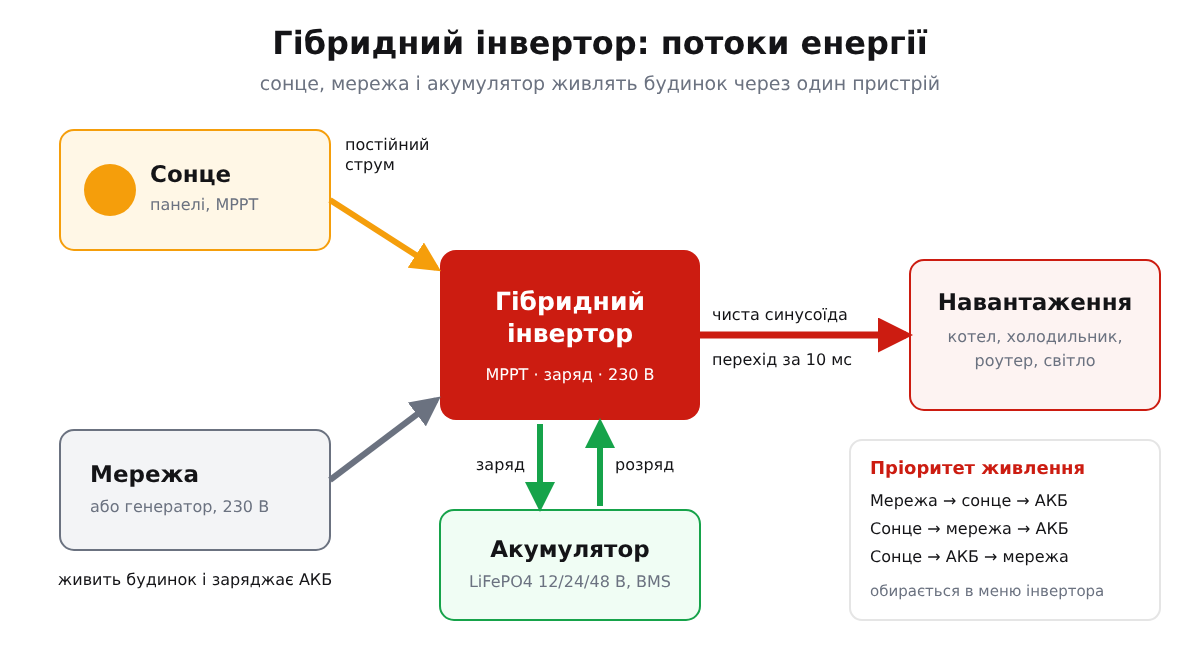
A hybrid inverter is the heart of a modern backup power system: in one housing it combines a pure sine wave inverter, an MPPT controller for solar panels and a grid charger. It decides by itself where to take energy for the house from: the grid, the sun or the battery. Here we look at how the priority modes work, how quickly the inverter switches over during a power cut and how it differs from a grid-tie inverter.
What a hybrid inverter is
An ordinary inverter only converts the battery’s DC voltage into 230 V. A hybrid one does more. It has three units inside:
- an inverter that delivers a pure 230 V, 50 Hz sine wave for the boiler, pumps and appliances;
- an MPPT controller that draws the maximum energy from the solar panels;
- a charger that charges the battery from the grid or a generator.
Automation works between these units: it distributes energy between the sun, the grid, the battery and the load. That is why a hybrid inverter suits both simple backup power for an apartment and a full solar station for a house.
How a hybrid inverter works with the grid, the battery and the sun
During the day, when the sun is shining, the panels power the house through the MPPT controller, and the surplus goes to charging the battery. When there is little sun, the inverter adds energy from the grid. If the grid goes down, the load automatically switches to the battery, and the panels keep recharging it. When the power comes back, the inverter again takes power from the grid and charges the battery.
The order in which the inverter uses the sources is set in the menu. These are the priority modes.
Priority modes: grid, sun or battery
Most hybrid inverters have three main load supply priority modes. In the menu they are often marked with abbreviations, for example USB, SUB, SBU, where U is the grid (utility), S is solar and B is the battery. See the manual of the specific model for the exact names and menu items.
| Mode | How it works | Who it suits |
|---|---|---|
| Grid first | The house runs on the grid, the battery is kept charged and comes on only during a power cut | Backup power without panels, maximum reserve in case of an outage |
| Sun first, then grid | The sun powers the load, the grid makes up the shortfall, the battery is kept in reserve | A solar station with full reserve for the night and for outages |
| Sun, then battery, then grid | First the sun, then energy from the battery, the grid only when the battery has discharged to a set level | Maximum use of your own solar energy |
Battery charging priority is set separately: from the sun first, from the sun and the grid together, or from the sun only. For example, the POWLAND SMS-5kW 24V WiFi offers sun, battery or grid priority, and charging can be done from the sun and the grid together or from the sun only. We also explained the logic of this kind of source selection in our guide on the priority relay.
Important
In a mode where the battery works every day, set a sensible threshold for returning to the grid so that the battery still has a reserve left for an evening power cut. The inverter is connected to the distribution board only by a qualified electrician.
Transfer time and pure sine wave
When the grid disappears, the inverter switches the load to the battery. In most inverters in our catalogue this takes 10 ms: that is the figure stated for the POWGROW SMS-5kW and EASUN SMS-6.5KP WiFi, while in the GSIKE 11kW and EASUN SMT-4KW it is 10 ms in fast mode and 20 ms in home appliance mode. For a boiler, fridge, router and computer such a transfer usually goes unnoticed.
A pure sine wave output means the voltage waveform is the same as in a good-quality grid. This matters for gas boilers, circulation pumps and appliances with electronics: on a modified sine wave they may hum, overheat or refuse to work.
WiFi monitoring: models in the catalogue
WiFi lets you see energy flows, battery charge and panel generation from your phone, and some models also let you change settings. Among the inverters in our catalogue, the following have WiFi:
- POWLAND SMS-5kW 24V WiFi: 5 kW, 24 V system, WiFi module included, communication with the BMS via RS485/CAN.
- EASUN SMT-4KW 24V: WiFi collector included, Solar of Things app, panel input up to 500 V.
- EASUN SMS-6.5KP 6.5kW 48V WiFi: 6.5 kW, 48 V system, panels up to 9,000 W, parallel operation of up to 9 inverters.
- GSIKE 11kW 48V WiFi: 11 kW, two MPPTs of 5,500 W each, SmartESS app, up to 6 inverters in parallel.
- POWGROW SMS-5kW 24V: WiFi monitoring of energy flows and battery charge, two outputs.
Simpler models, such as the ECGSOLAX 12V 1kW, have no WiFi or BMS communication port: that is enough for a boiler and a router, but you will have to monitor the system from the display. See all models in the inverters section.
How a hybrid inverter differs from a grid-tie inverter
A grid-tie inverter is designed only to feed solar panel energy into the house wiring. It has no battery, and during a power cut it shuts down for safety reasons, even if the sun is shining. In other words, a grid-tie inverter gives no backup power.
A hybrid inverter works with a battery and can power the house autonomously when there is no grid. Some models, for example the POWLAND SMS-5kW and GSIKE 11kW, can also work without a battery, from the sun and the grid, with the battery added later. For Ukraine, with its power cuts, the hybrid scheme is usually the most practical. Read about the payback of solar panels in our guide payback of a 5 kW station.
Frequently asked questions
Can a hybrid inverter be installed without solar panels?
Yes. It then works as a backup power kit: it charges the battery from the grid and powers the house during outages. Panels can be added later.
Which battery do I need?
One with the same voltage as the inverter: 12, 24 or 48 V. LiFePO4 with BMS communication suits best. Choose one in the batteries section or take a ready-made battery + inverter kit.
Does a hybrid inverter deliver full power from the battery?
Sustained output is limited by the battery’s BMS current. Full inverter power from the battery can only be obtained with a battery of a suitable current rating or several batteries in parallel.
Does it need the internet to work?
No. WiFi is needed only for monitoring; the inverter works without it.
Expert opinion
The advantage of a hybrid inverter is that it grows with your needs: today it is backup power from a battery, tomorrow solar panels, and later a bigger battery. The main thing is to choose the right system voltage and power for your actual appliances, and to set the priority and charging modes for your specific battery. Then the system works automatically and needs no attention.
We will help you choose a hybrid inverter, battery and solar panels and carry out turnkey installation in Dnipro and the region. Call us: 093 293 93 93 or 099 054 40 38.