
The optimal distribution board for an apartment: protection, circuits and room for a battery + inverter kit
Many apartments still have a board with three or four breakers, where one line feeds half the apartment. Switch on the kettle, microwave and washing machine together, and everything goes off. And when outages start, it turns out that an inverter cannot be connected to such a board without rework. An optimal apartment board solves both problems: it protects people and appliances and has a separate backup group for a battery + inverter kit.
Who needs it
- You are renovating your apartment and replacing the wiring.
- The board has old breakers without RCDs, the groups are unlabelled, and things “trip” all the time.
- You want the router, fridge, lighting and gas boiler to work during outages.
- Your building has voltage surges, or there has been a “broken neutral” incident after which appliances burnt out.
Floor board and apartment board: who is responsible for what
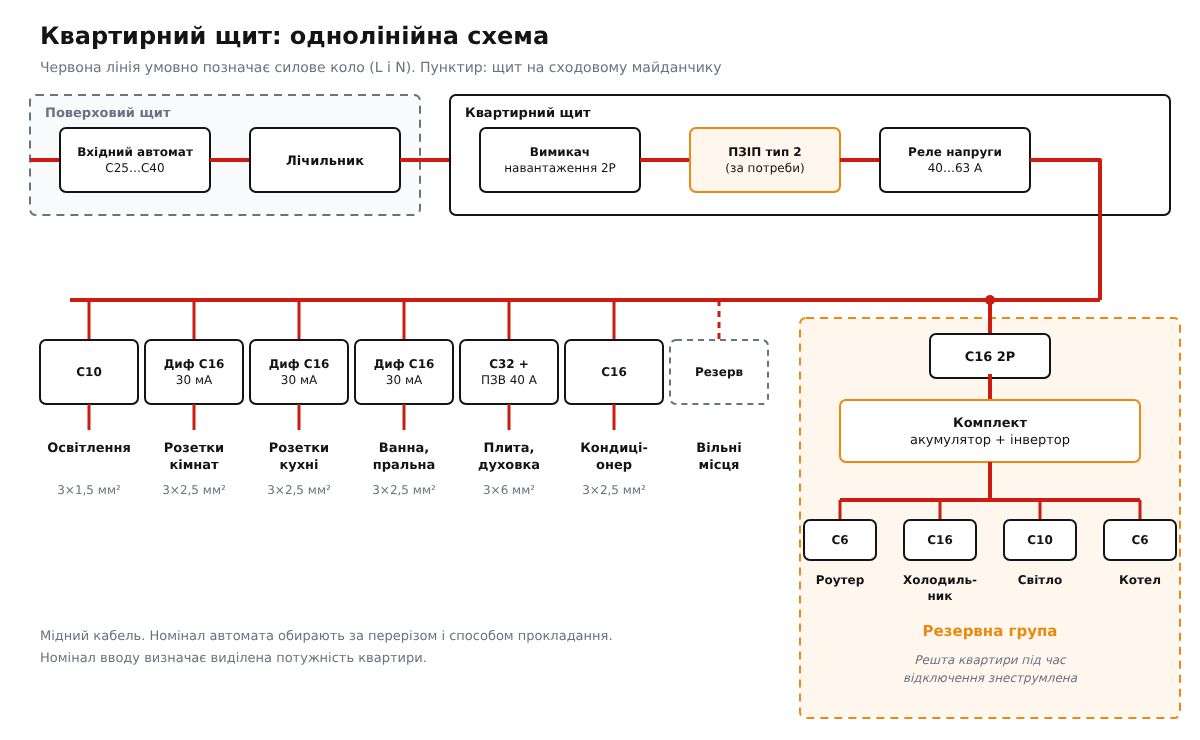
An apartment building usually has two boards. The floor board on the landing holds the apartment’s main breaker and the meter; it is maintained by the power company or the building manager. The apartment board in the hallway holds everything responsible for the safety of your own apartment. You assemble it as you see fit.
What goes into the apartment board, in order:
- 2P switch disconnector. Lets you de-energise the whole apartment in one move without running out to the landing. Its rating is no lower than the main breaker in the floor board.
- Type 2 SPD. Protects against surges in the building’s network. It is only effective if there is a PE conductor, so in buildings without earthing discuss whether it makes sense with an electrician.
- Voltage relay. For an apartment, this is perhaps the most important module. If the neutral in the riser breaks, the voltage in the sockets can rise almost to 380 V, and the relay will disconnect the apartment before the appliances burn out. The relay rating is chosen with a margin relative to the main breaker, typically 40–63 A.
- Group breakers and 30 mA RCBOs. Lighting, room sockets, kitchen, bathroom, cooker, air conditioner.
- Backup group. A separate breaker for the inverter input and a separate busbar after it.
Groups for a typical apartment
| Group | Breaker | Cable (copper) | Residual current protection |
|---|---|---|---|
| Lighting | C10 | 3×1.5 mm² | As designed |
| Room sockets (1–2 lines) | C16 | 3×2.5 mm² | 30 mA RCBO |
| Kitchen sockets | C16 | 3×2.5 mm² | 30 mA RCBO |
| Bathroom, washing machine | C16 | 3×2.5 mm² | 30 mA mandatory |
| Electric cooker | C32 | 3×6 mm² | RCD 40 A / 30 mA |
| Air conditioner | C16 | 3×2.5 mm² | As per the appliance datasheet |
| Inverter input | As per the inverter datasheet, e.g. C16 | 3×2.5 mm² for C16 | As per the manufacturer’s diagram |
These are typical values with a margin that electricians use for concealed copper wiring. The final ratings are determined by the cable cross-section, length and installation method according to the PUE and DBN V.2.5-23 (Ukrainian electrical rules). The apartment’s total power is limited by the allocated capacity, so compare the total load of the groups with the rating of the incoming supply.
Layout: a 36-module board
For a two- or three-room apartment with an electric cooker, a 36-module board (3 rows of 12) is usually enough. If the cooker is gas and there are no air conditioners, 24 modules may do, but spare space never hurts.
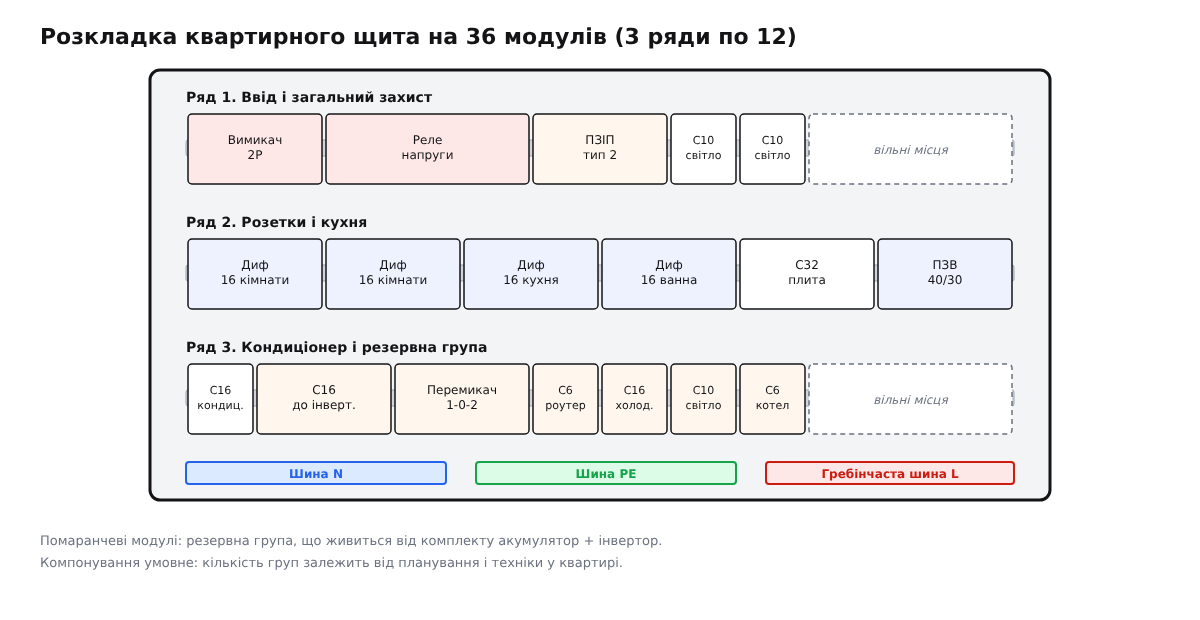
The orange modules in the picture are the backup group. It is convenient to keep it in a separate row: the electrician can see at once what is fed from the inverter. Label every breaker and put the board diagram inside the door.
Where the battery + inverter kit connects
The most common mistake: the inverter is plugged into a socket and extension leads run from it all over the apartment. This is inconvenient and dangerous. The right way to do it:
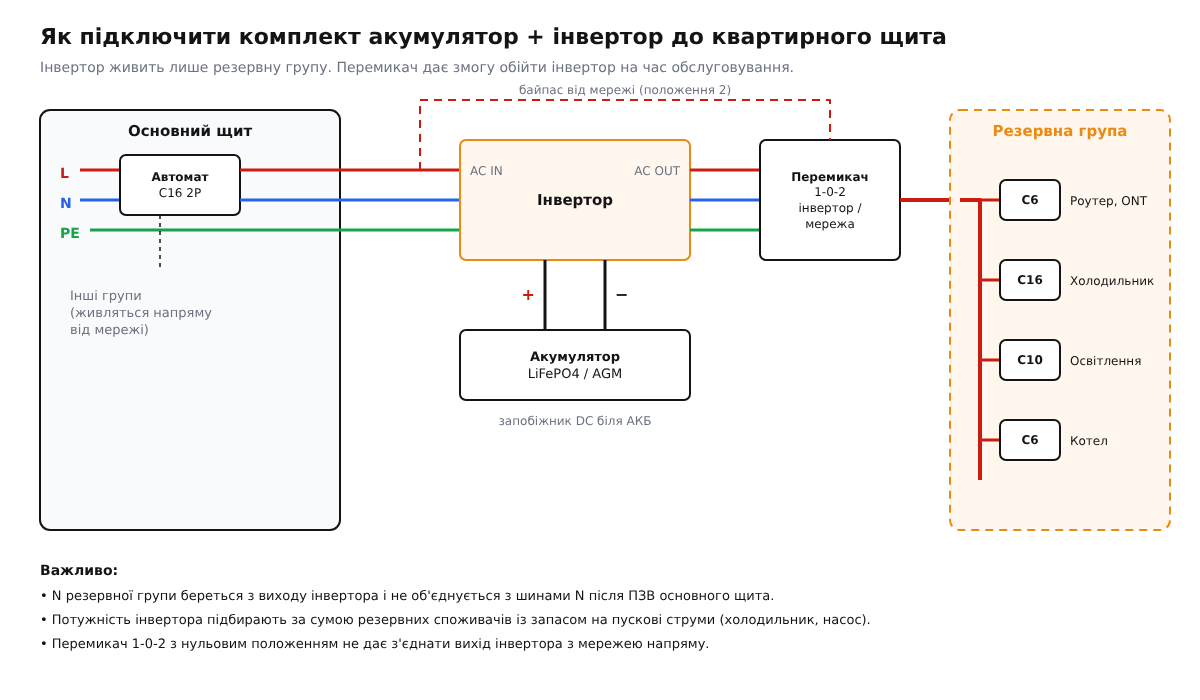
- The inverter input (AC IN) is connected through a separate breaker from the board’s main busbar. While the grid is on, the inverter passes it through to the output and charges the battery.
- The inverter output (AC OUT) feeds a separate backup busbar with its own breakers: the router and fibre terminal, the fridge, the lighting, the gas boiler.
- A 1-0-2 switch lets you feed the backup group directly from the grid while the inverter is being serviced. The zero position prevents the inverter output from being connected to the grid.
- The backup group neutral is taken from the inverter output and is not joined to the main board’s N bars after the RCDs. Check the N and PE connection scheme at the output against the manual of your specific inverter.
- The battery is connected to the inverter with short cables of a suitable cross-section, with a fuse next to the battery.
The inverter power is chosen from the total power of the backup loads, with a margin for the starting currents of the fridge and boiler pump. The battery capacity depends on how many hours you need to hold out.
How to do it yourself: step by step
- Find out the supply rating. See which breaker is in the floor board and what capacity is allocated to the apartment.
- Make a list of groups. Rooms, kitchen, bathroom, cooker, air conditioners. List separately what must run on backup.
- Choose the modules. Switch disconnector, SPD, voltage relay, breakers and RCBOs from the table, a breaker for the inverter input, a 1-0-2 switch and the backup group breakers.
- Choose the enclosure. Count the modules and add a 20–30% reserve. The enclosure must have separate N and PE bars.
- Run the backup lines. During renovation, lay separate cables to the fridge, boiler, router and the light fittings that should work on backup.
- Assemble and label. Comb busbars, the neutral of each group after its own RCBO, and markings on every module.
- Test it. Press “Test” on every RCD, check that the voltage relay works and that the backup group switches to the inverter when the incoming supply is off.
Safety first
Do all work in the board only with the main breaker off and after checking with a tester that there is no voltage. Remember that the inverter is itself a 230 V source: switch it off too before working on the backup group. Any work on the floor board must be agreed with the power company or the building manager. The installation must comply with the PUE and DBN V.2.5-23, so if you lack experience, have the work done by a qualified electrician.
Expert opinion
For an apartment, we consider three things a mandatory minimum: a voltage relay at the incoming supply, 30 mA protection on the sockets and bathroom, and separate labelled groups. And the fourth thing, without which we no longer build any board today, is a backup group for a battery + inverter kit. Even if you do not have an inverter yet, leave room for it in the board and run separate cables to the boiler, fridge and router. During renovation it costs next to nothing; after renovation it means chasing channels in freshly finished walls.
Need an apartment board with a backup group, or an inverter connected to your existing board? We do turnkey installation in Dnipro. Call us: 093 293 93 93, 099 054 40 38. MinerTech engineers will select a kit and scheme for your apartment.