
Cables for the battery and inverter: cross-section, length and terminals
The cables between the battery and the inverter look like a small detail, but during a power cut they carry all the current that powers the house. A thin or overly long cable heats up and “eats” voltage, and the inverter may shut down under load even with a brand-new LiFePO4 battery. Here we explain how to estimate the current, why the cable must be short and thick, what M8 terminals are and why you need a DC breaker.
Why the battery current is so high
The inverter converts the battery’s low DC voltage (12, 24 or 48 V) into 230 V AC. The power stays the same, so the lower the battery voltage, the higher the current. The approximate formula is simple:
I ≈ P ÷ (U × 0,9)
where P is the load power in watts, U is the battery voltage, and 0.9 accounts for the inverter efficiency (in most of our models it is up to 93–94%, but we allow a margin). Example: a 1 kW inverter running from a 12.8 V battery draws about 90 A. The same kilowatt from a 51.2 V battery is only about 22 A. That is exactly why powerful systems are built on 24 or 48 V.
Inverter cable cross-section: a guide table
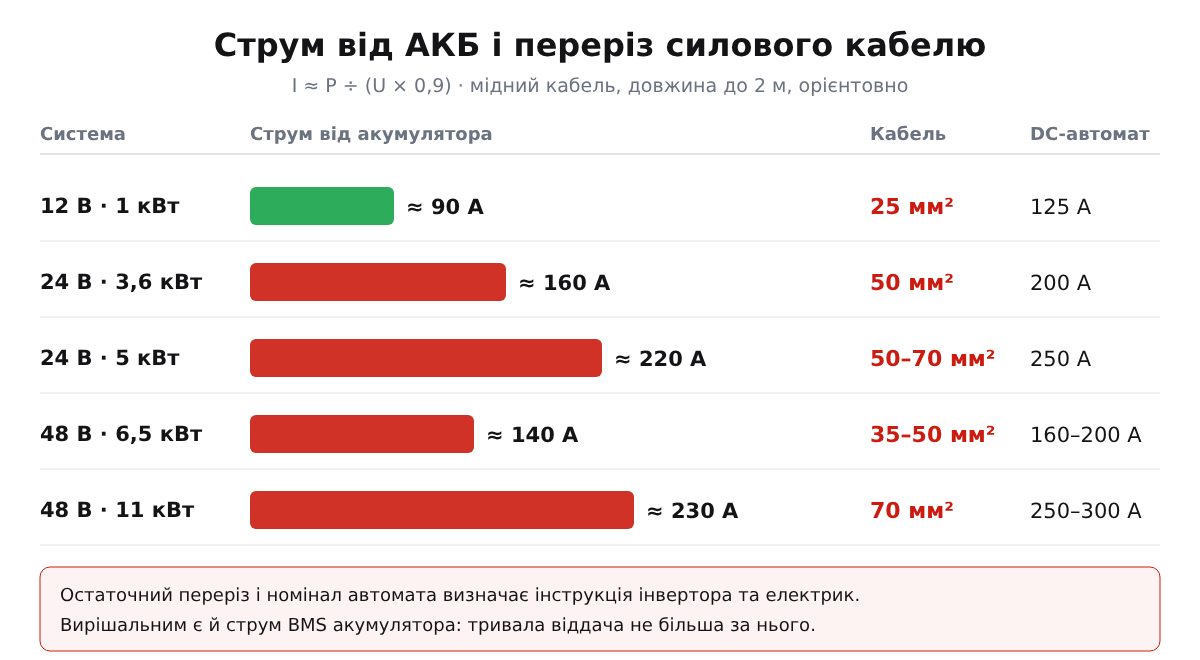
We deliberately give conservative values for copper cable up to 2 m long. This is a starting point for discussion, not a substitute for a calculation.
| System | Battery current | Copper cable cross-section | DC breaker, approx. |
|---|---|---|---|
| 12 V, 1 kW | ≈ 90 A | 25 mm² | 125 A |
| 24 V, 3.6 kW | ≈ 160 A | 50 mm² | 200 A |
| 24 V, 5 kW | ≈ 220 A | 50–70 mm² | 250 A |
| 48 V, 6.5 kW | ≈ 140 A | 35–50 mm² | 160–200 A |
| 48 V, 11 kW | ≈ 230 A | 70 mm² | 250–300 A |
For example, in the description of the POWLAND SMS-5kW 24V WiFi inverter we state plainly that 5 kW from a 24 V battery means more than 200 A, so power cables of at least 50 mm² and a 250 A DC breaker are required.
Important
The final cable cross-section, breaker rating and terminal tightening torque are determined by the manual for the specific inverter and battery and by a qualified electrician. The table above only shows the order of magnitude.
Why the cable must be short and thick
Every cable has resistance. The longer and thinner it is, the higher the resistance, and at a current of 100–200 A even hundredths of an ohm cause noticeable losses. This shows up as:
- heating of the cable and lugs, especially at the crimp points;
- voltage drop at the inverter input: when a powerful appliance starts, the inverter “sees” a lower voltage than the battery actually has and may shut down with a low-voltage error;
- energy losses that are simply dissipated as heat.
That is why the battery is placed as close to the inverter as possible and the shortest cable length that still allows a convenient layout is chosen. Both cables, positive and negative, must have the same cross-section: the current flows through both.
M8 terminals: what they are and how to connect them
M8 is the terminal bolt size: a thread 8 mm in diameter. The power cable lug has a hole for this bolt. These terminals are found on most of the lithium batteries and inverters we sell. A few practical rules:
- the lug must be crimped properly with a special tool, not screwed on or “squashed” with pliers;
- the bolt is tightened firmly, because a loose contact heats up under high current;
- there must be no washers or nuts between the lug and the terminal that prevent direct contact, unless the manual says otherwise;
- first connect everything with the DC breaker switched off and check the polarity.
Fuse or DC breaker: mandatory
A DC breaker or fuse must always be fitted in the positive wire between the battery and the inverter. A LiFePO4 battery can deliver a huge current in a short circuit, and it is the breaker that opens the circuit before the cable overheats. It is also a convenient way to disconnect the battery during maintenance. The breaker must be rated for direct current and for the voltage of your system. The rating is chosen so that it is not lower than the operating current and not higher than the cable can withstand. Some inverters, for example the GSIKE 11kW 48V WiFi, come with a battery fuse included. Look for breakers and other installation small parts in the Miscellaneous. Components section.
Ready-made M8-M8 power cables: 1.25, 1.5 and 2 m
To avoid crimping the lugs yourself, you can take a ready-made set. The catalogue has three lengths:
Each set consists of two cables, “+” and “−”, with lugs for an M8 bolt at both ends. The lugs are already crimped, so no special tool is needed. Purpose: connecting the battery to the inverter, and also connecting batteries to each other in parallel. Choose the shortest option that is enough for your layout, and check with us whether the cross-section suits the power of your inverter.
Note: some batteries already come with power cables, for example the DATOU BOSS 25.6V 314Ah 8.03kWh. Sustained system output is also limited by the BMS: with this battery (150 A BMS) it is about 3.8 kW even with a more powerful inverter.
Frequently asked questions
Can I use welding or car cable?
What matters is the copper cross-section, the quality of the lugs and the crimping. It is better not to fit a doubtful cable of unknown cross-section.
Can I extend the cable if the battery is far away?
It is better to move the battery closer to the inverter. A long cable needs a larger cross-section and still causes higher losses.
Why do the cables heat up even though the cross-section is correct?
Most often the cause is a poorly tightened terminal or poor-quality crimping of the lug. Switch off the load and the breaker and contact a specialist.
Do I need a breaker if the battery has a BMS?
Yes. The BMS protects the battery, while the DC breaker protects the cable and lets you disconnect the battery safely.
Expert opinion
Most problems with backup power systems are caused not by the inverter or the battery, but by thin cables, poorly tightened terminals and a lack of protection. That is why we advise calculating the current from the inverter power, keeping the cables short, fitting a DC breaker in the positive wire and checking everything against the manual. If you buy a battery + inverter kit, we will select the cables and breaker for it, and in Dnipro and the region we will do turnkey installation.
Need advice on cables for your inverter? Call us: 093 293 93 93 or 099 054 40 38.