
Priority relay: how to stop the main breaker tripping when your supply capacity falls short
Does your main breaker trip as soon as the oven, kettle and water heater are on at the same time? It is a familiar situation in many houses and apartments with an allocated capacity of 3–7 kW. Increasing it takes a long time and costs a lot, and often it is simply impossible. There is a simpler solution: a priority relay. It briefly switches off the “secondary” loads when the important ones are short of power, and switches them back on as soon as the load drops.
Who needs it
- Your incoming supply capacity is limited (for example, a 16–25 A breaker) and it trips from time to time.
- You have powerful appliances that do not have to run at the same time: a water heater, underfloor heating, a heater, a washing machine, an electric car charger.
- You power your home from an inverter and want to keep it from overloading: the same principle helps take the load off a battery + inverter kit.
How a priority relay works
All loads are split into two groups:
- Priority: whatever must work whenever you switch it on (kitchen, lighting, boiler, fridge, computer).
- Non-priority: whatever can wait a few minutes without any inconvenience (the water heater keeps the water hot, the underfloor heating will not cool down while the kettle boils).
The relay measures the current constantly. While it is below the set threshold, both groups run. When the current exceeds the threshold, the relay opens its contact and switches off the non-priority group. When the current falls below the threshold again, the relay switches it back on automatically. Switching takes a fraction of a second, so the main breaker simply has no time to trip.
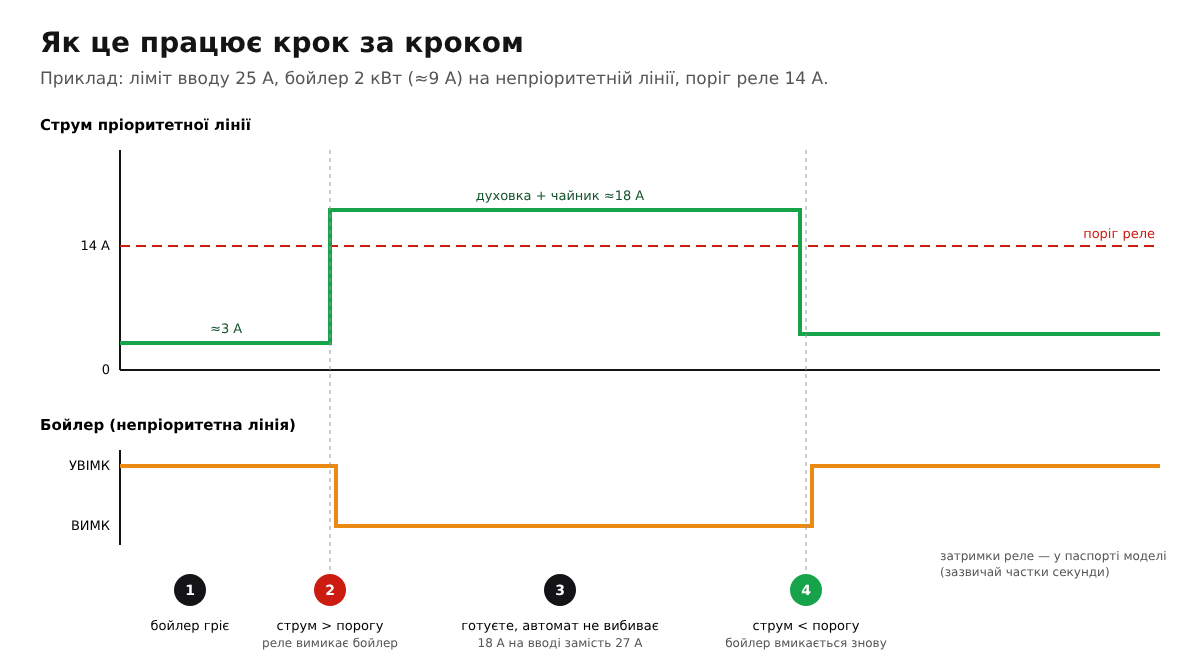
The graph shows four steps:
- The priority line is almost unloaded (≈3 A), and the water heater quietly heats the water.
- You switch on the oven and kettle: the priority line current jumps to ≈18 A and exceeds the 14 A threshold. The relay immediately switches off the water heater.
- You cook, and the incoming supply carries 18 A instead of 27 A. The 25 A breaker does not trip.
- The oven has heated up and its thermostat has switched it off, so the current falls below the threshold. The relay switches the water heater back on by itself.
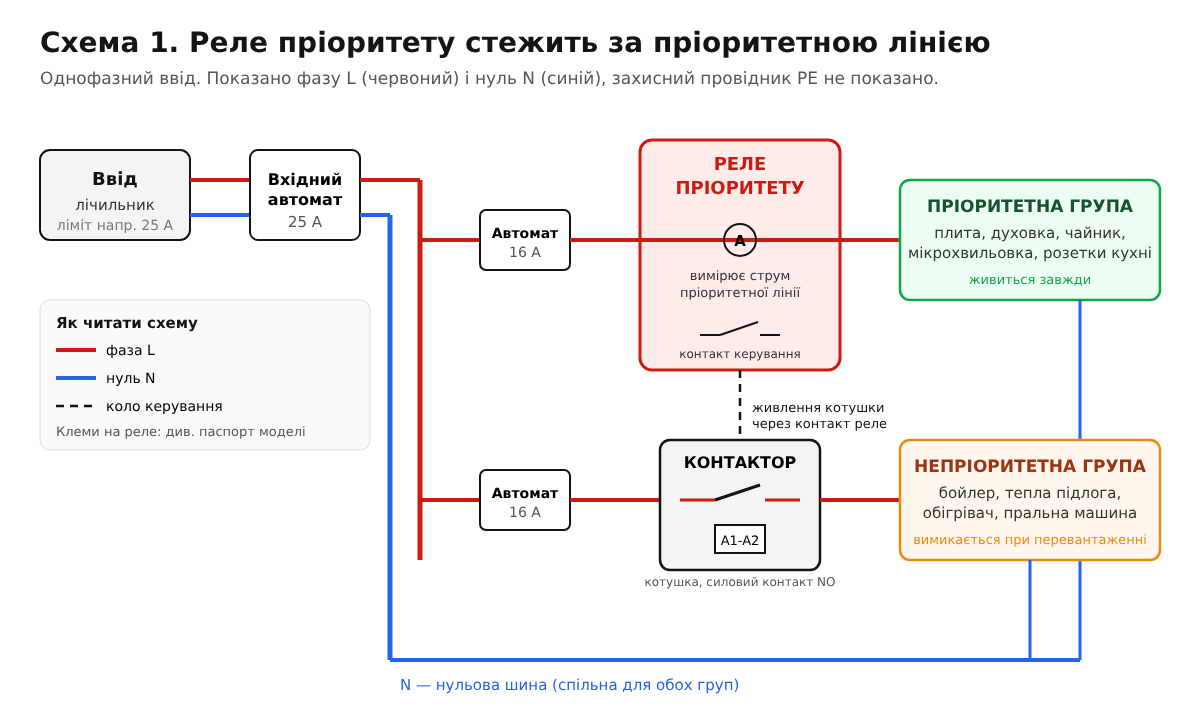
Diagram 1. The relay monitors the priority line
The most common option for an apartment or a small house. The phase of the priority line passes through the relay’s measuring channel, and the relay contact controls the coil of a contactor that feeds the non-priority group.
How to choose the threshold. Threshold = supply limit − non-priority group current − a small margin. Example: a 25 A main breaker, and a 2 kW water heater draws about 9 A (2000 W ÷ 230 V). 25 − 9 = 16 A, and with a margin we set 14 A. Then even in the worst case the incoming supply will not exceed 23 A.
Why a contactor. The built-in contact of most relays is rated for about 16 A of resistive load. A small water heater can be connected directly through the contact, but for underfloor heating, several appliances or an inductive load it is better to fit a modular contactor of a suitable rating: the relay controls only its coil, and the power current flows through the contactor.
Diagram 2. Monitoring the total incoming current
If the load is spread across many lines, it is easier to monitor the whole house rather than a single line. For this you use a current relay with a remote current transformer (CT): the ring is put on the phase wire right after the main breaker, and the relay “sees” the total consumption.
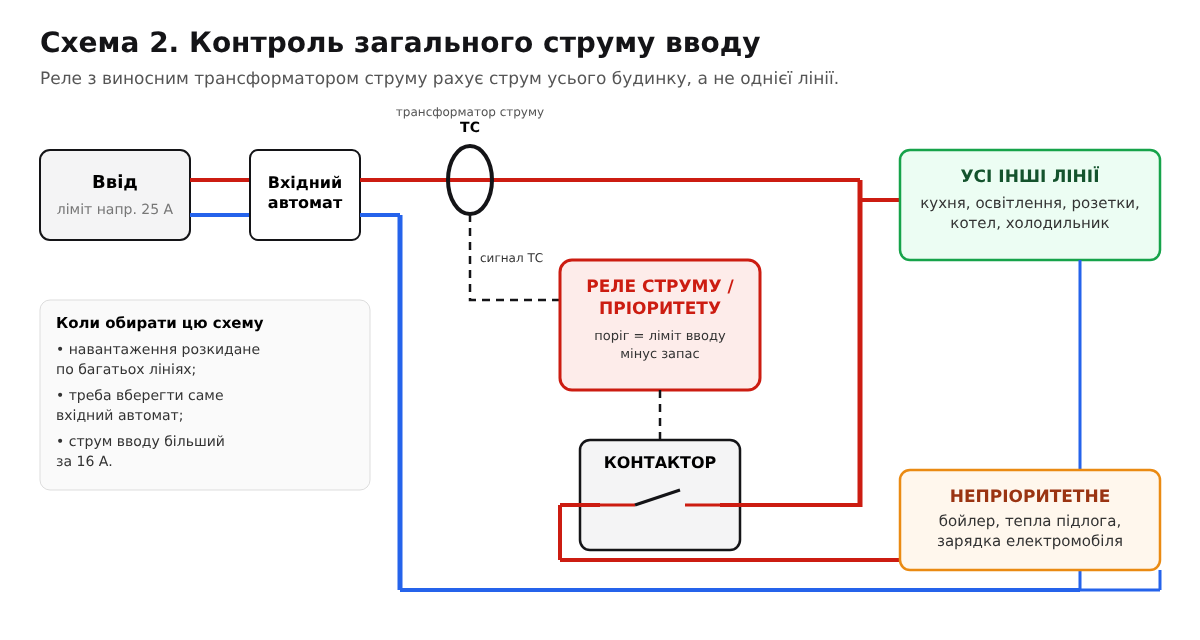
Here the threshold is set slightly below the main breaker rating (for example, 22 A for a 25 A breaker). Once it is exceeded, the relay switches off the non-priority load. This scheme also suits a three-phase supply: there are three-phase priority relays that monitor the current of each phase.
Which relays are suitable
In electrical shops, search for “priority relay” or “current relay for disconnecting non-priority loads”. Typical examples that are easy to find in Ukraine:
| Type | Examples | When to choose |
|---|---|---|
| Single-phase relay with pass-through measurement | F&F PR-613 (setting 2–15 A), PR-615 (4–30 A) | Diagram 1: apartment, kitchen + water heater |
| Relay with a remote current transformer | F&F PR-614 | Diagram 2: monitoring the whole supply, high currents |
| Modular priority relay | Hager ED183 (9–39 A) | A house with a supply of up to ~40 A |
| Three-phase current relay | electronic relays for 40–100 A | Three-phase supply, detached houses |
The setting ranges are taken from the manufacturers’ catalogues. Terminal markings and the exact wiring differ between models, so connect strictly according to the datasheet of your specific relay.
How to assemble it yourself: step by step
- Work out the limit. The main breaker rating (or the allocated capacity ÷ 230 V) gives the maximum incoming current.
- Split the loads. List the powerful appliances and decide what can wait. Usually that means the water heater, underfloor heating and heaters.
- Choose the scheme. One or two loaded lines: diagram 1. Many lines or a three-phase supply: diagram 2.
- Pick the components. A priority relay, a modular contactor with a 230 V coil rated for the non-priority group current with a margin, separate breakers for each group, and free space on the DIN rail in the board.
- Regroup the lines in the board. Non-priority appliances must be fed by a separate line through the contactor’s power contacts.
- Connect the relay according to the datasheet. The priority line phase goes through the measuring channel (or the CT ring goes on the incoming supply), plus the relay power supply, and the relay contact goes into the contactor coil circuit.
- Set the threshold and test. Use the formula above for the threshold. Then switch on all priority appliances together and make sure the non-priority group switches off while the main breaker holds.
Safety first
Do all work in the board only with the incoming supply switched off and after checking that there is no voltage. If you have no experience with distribution boards, have the installation done by a qualified electrician. Breaker ratings and wire cross-sections must match the load.
Expert opinion
A priority relay costs many times less than increasing your allocated capacity, and it takes a couple of hours to install. For most apartments and houses with a limited supply, it is the smartest first step. We use the same approach when selecting battery + inverter kits: a properly split load lets you choose a lower-power inverter and run longer on the battery during outages.
Not sure which option to choose, or want a turnkey installation in Dnipro? Write or call us: 093 293 93 93, 099 054 40 38. MinerTech engineers will advise on your specific task.