
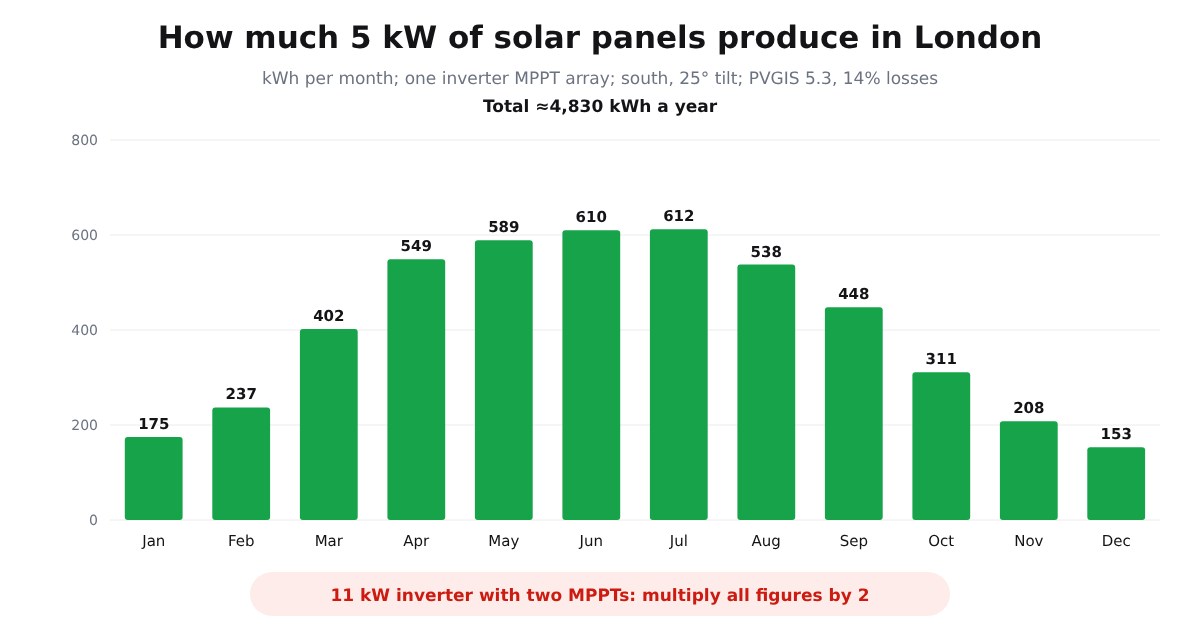
How much do 5 kW of solar panels produce in London: calculation for one inverter MPPT input
The most common question from customers: “How much electricity will the panels give?” We answer with a specific example: 5 kW of solar panels. That is how much is usually connected to one MPPT input of a hybrid inverter, i.e. to one panel “array”. The figures for London are taken from PVGIS, a European Commission service, with all losses taken into account.
What an MPPT array is and why 5 kW
MPPT (maximum power point tracker) is an inverter input that “squeezes” the maximum energy out of a group of panels in any sunlight. Panels connected to one MPPT are called an array or a string. For typical 5–6 kW hybrid inverters, one array is about 5 kW of panels, for example 8 panels of 630 W each. We always choose the exact number of panels in a string to suit the permissible voltage of the specific inverter.
An 11 kW inverter usually has two MPPTs, i.e. two such arrays. So for it, simply multiply all the figures below by 2.
How much 5 kW of panels produce month by month
Calculation for a south-facing roof with panels tilted at 25°, in London (PVGIS 5.3, 14% losses in cables, inverter and from heating):
| Month | 5 kW, kWh per month | 5 kW, kWh per day | 2 × 5 kW (11 kW, 2 MPPTs) |
|---|---|---|---|
| January | 175 | 5.6 | 350 |
| February | 237 | 8.5 | 474 |
| March | 402 | 13.0 | 804 |
| April | 549 | 18.3 | 1,098 |
| May | 589 | 19.0 | 1,178 |
| June | 610 | 20.4 | 1,220 |
| July | 612 | 19.7 | 1,224 |
| August | 538 | 17.4 | 1,076 |
| September | 448 | 14.9 | 896 |
| October | 311 | 10.0 | 622 |
| November | 208 | 7.0 | 416 |
| December | 153 | 5.0 | 306 |
| Year | ≈4,830 | ≈13.2 | ≈9,660 |
Over a year, one 5 kW array gives ≈4,830 kWh, an average of 13 kWh a day. In summer that is about 20 kWh a day, and in December only about 5. If the panels stand on the ground at the optimal angle of about 40°, the yield is slightly higher, about 5,100 kWh a year. Shade from trees, neighbouring buildings or a chimney can reduce it considerably.
What that means in pounds
- For a home at the Ofgem price cap rate of 26.32p/kWh (October–December 2026): 4,830 kWh is ≈£1,270 a year, if you consume all the energy yourself.
- For a business at a price of ≈28.6p/kWh excluding VAT: ≈£1,380 a year from one array.
- An 11 kW inverter with two arrays: ≈9,660 kWh, i.e. ≈£2,540 a year for a home or ≈£2,760 for a business.
For a detailed payback calculation of a large business station, with equipment costs, surplus and a sensitivity table, see below: the 30 kW station breakdown.
Business breakdown: payback of a 30 kW solar station
In Great Britain, a small business pays about as much for a kilowatt-hour as a household: 28.59p excluding VAT for businesses using 20–499 MWh a year (DESNZ, Q2 2026) versus 26.32p under the household price cap (Ofgem, October–December 2026), and the very smallest businesses pay 38.36p. Your own solar station on the roof of a shop, car service centre, warehouse or small workshop is therefore not a “green toy”, but an ordinary investment with a calculation behind it. We have worked out the payback of a 30 kW station in London step by step, with open assumptions, so that you can plug in your own figures.
What payback depends on
- The price of your electricity. Every kilowatt-hour from the panels that you consume yourself is a kilowatt-hour you do not have to buy from the supplier.
- The share of self-consumption. It pays best when the business operates during the day and “eats” the energy straight away. Surplus can also be sold, but for much less.
- The station’s yield. It depends on the region, orientation, angle and shade.
- The turnkey cost of the station and maintenance costs.
Step 1. How much electricity costs for a business
The UK government publishes the average prices actually paid by non-domestic consumers. According to DESNZ Quarterly Energy Prices (table 3.4.2, published on 29 September 2026), in Q2 2026 businesses paid, including the Climate Change Levy and excluding VAT, 28.59p/kWh as small consumers (20–499 MWh a year), 38.36p as very small consumers (up to 20 MWh) and 24.51p on average across all sizes.
For the calculation we take 28.6p/kWh excluding VAT. A VAT-registered business reclaims VAT on its electricity bills. Your exact price is on your supplier’s bill: simply divide the amount excluding VAT by the number of kWh. Note that the station cost in step 3 includes VAT where it was charged, so for a business that reclaims VAT the investment is lower (see the £30,000 line in the sensitivity section).
Step 2. How much a 30 kW station will produce in London
According to PVGIS (a European Commission service), a 30 kW rooftop station facing south with a 25° tilt in London produces ≈29,000 kWh a year, i.e. about 967 kWh per kilowatt of panels. This already includes losses in the cables, the inverter and from panel heating.
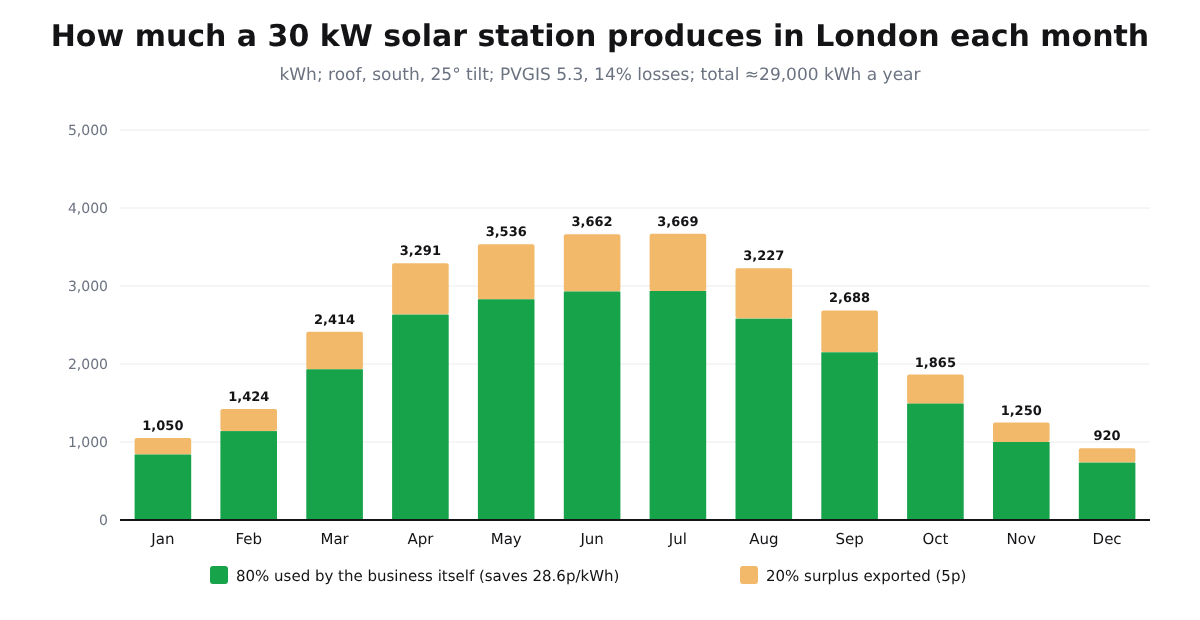
In summer the station produces about 4 times more than in December (≈3,670 kWh in July versus ≈920 kWh). That is why a solar station is ideal for a business with high daytime consumption in summer (air conditioners, refrigeration equipment, machine tools): peak production coincides with peak consumption.
Step 3. How much a turnkey station costs
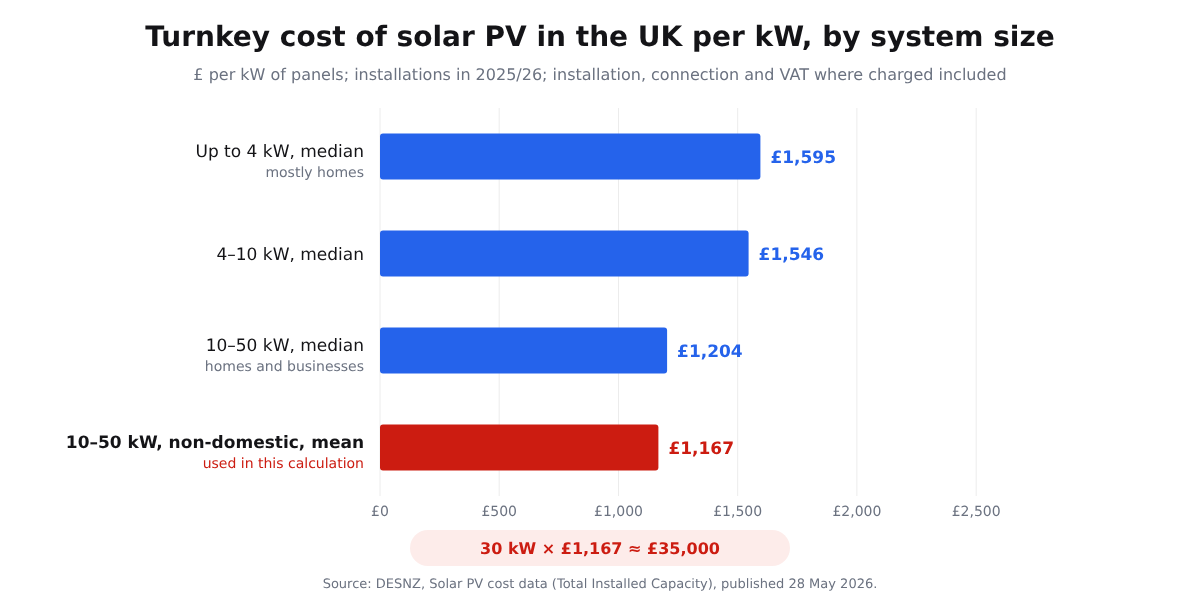
The UK government publishes the actual installed costs of solar stations (DESNZ, Solar PV cost data, 28 May 2026). For non-domestic systems of 10–50 kW installed in 2025/26, the average turnkey cost was £1,167 per kW, i.e. ≈£35,000 for 30 kW. The median for all 10–50 kW systems is £1,204 per kW, and small home systems cost more per kilowatt: £1,546 at 4–10 kW and £1,595 up to 4 kW. The figures include installation and connection, and VAT where it was charged. The real cost depends on the roof, the distance to the board and the chosen equipment, so the sensitivity table also shows a more expensive option.
Step 4. Payback calculation
| Indicator | Value | Source |
|---|---|---|
| Station capacity | 30 kW | Example |
| First-year yield | 29,000 kWh | PVGIS 5.3: London, roof, south, 25° |
| Self-consumption | 80% (23,200 kWh) | Assumption: the business operates during the day |
| Grid purchase price | 28.6p/kWh excl. VAT | DESNZ: small businesses (20–499 MWh a year), Q2 2026, 28.59p incl. Climate Change Levy |
| Surplus selling price | 5p/kWh | Assumption: SEG tariffs 3–6p (MoneySavingExpert, 9 November 2026) |
| Investment | £35,000 | DESNZ: non-domestic 10–50 kW, 2025/26, £1,167 per kW |
| Maintenance | 1% of the investment per year (£350) | Assumption |
| Panel degradation | 0.5% per year | Assumption |
| Inverter replacement | In year 12, £3,000 | Assumption, at today’s price |
First year: 23,200 kWh × 28.6p = £6,635 saved on bills, plus 5,800 kWh of surplus × 5p = £290, minus £350 for maintenance. In total, ≈£6,580 of net benefit a year.
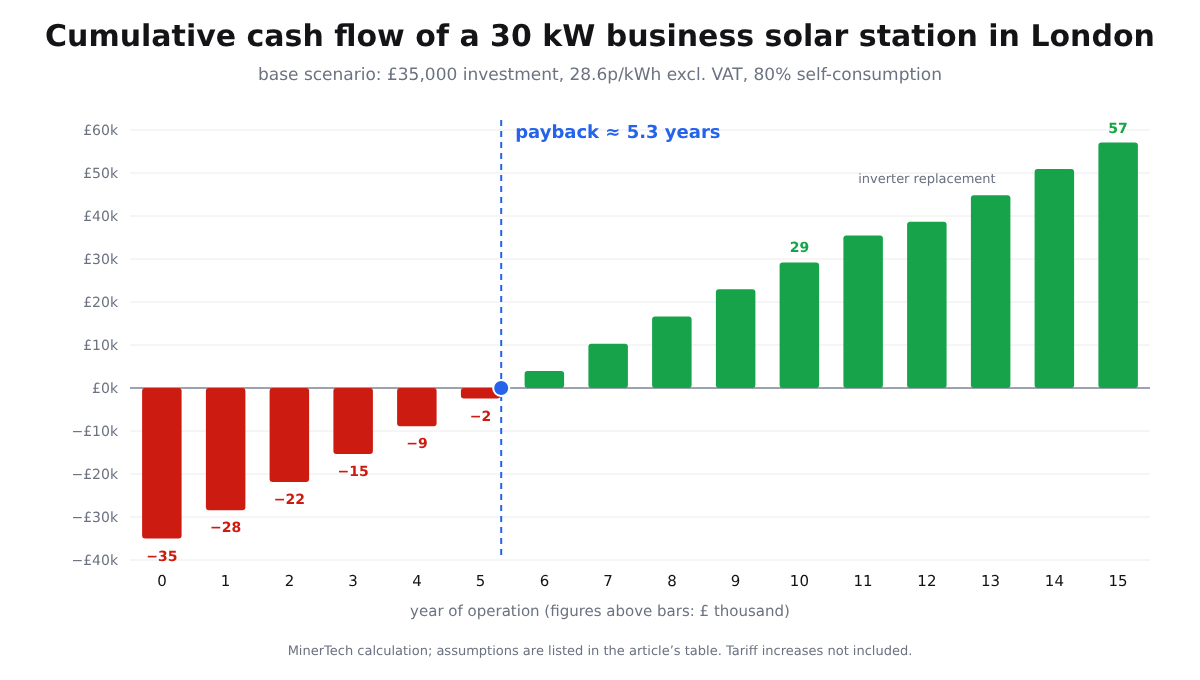
Result of the base scenario:
- simple payback period ≈5.3 years;
- cumulative benefit over 10 years ≈£29,200, over 25 years ≈£116,400 (not counting tariff increases);
- the cost of your own kilowatt-hour over 25 years ≈6.8p versus 28.6p from the grid.
Sensitivity table: what if conditions are different?
Payback period in years for a £35,000 investment, depending on the electricity price (excl. VAT) and the share of self-consumption:
| Price, p/kWh | 50% self-consumption | 65% | 80% | 100% |
|---|---|---|---|---|
| 20 | 10.7 | 8.9 | 7.6 | 6.4 |
| 24.5 | 8.9 | 7.3 | 6.2 | 5.2 |
| 28.6 | 7.7 | 6.3 | 5.3 | 4.4 |
| 35 | 6.4 | 5.2 | 4.3 | 3.6 |
Other factors:
- Station cost £30,000 (roughly the price without 20% VAT, if your business reclaims it): payback ≈4.5 years; £45,000 (≈£1,500 per kW, the price level of small home systems): ≈6.9 years.
- Yield 15% lower (shade, east or west, shallow roof): ≈6.3 years.
- No surplus sold at all: ≈5.6 years. Selling the surplus is a nice bonus, but not the basis of the economics.
- Pessimistic scenario (£45,000, 20p/kWh, only 50% self-consumption): ≈14.2 years. Over 25 years the station still pays for itself and brings in ≈£26,000 on top, but for such a business it is clearly oversized: first size the station to your daytime consumption.
Selling the surplus: the Smart Export Guarantee
In Great Britain, exported surplus is paid for under the Smart Export Guarantee (SEG): electricity suppliers offer export tariffs and set the rate themselves. As of 9 November 2026, the standalone SEG tariffs listed by MoneySavingExpert ranged from 3p to 6p per kWh; for our calculation we take 5p. That is almost six times less than the business purchase price, and summer surplus is not carried over to winter. That is why it pays to size a business station for your own daytime consumption, not for export.
How to calculate for your business: step by step
- Collect 12 months of bills. See how many kWh you consume each month and the price excluding VAT.
- Estimate daytime consumption. What share falls between 8:00 and 18:00? A shop, car service centre, office or warehouse with refrigerators usually uses most of its energy during the day.
- Choose the capacity. Rule of thumb: 1 kW of panels in London gives ≈970–1,020 kWh a year. A station that covers daytime consumption pays back fastest.
- Check the roof. Area (for example, one catalogue lists 180 m² of panels for a 30 kW kit, and more is needed with walkways), orientation, shade, load-bearing capacity.
- Plug in your own figures into the formula: annual benefit = yield × self-consumption share × price + surplus × selling price − maintenance. Payback = investment ÷ annual benefit.
- Think about backup. A grid-tied station without a battery stops during a power cut. If your business needs to work during blackouts, consider a hybrid scheme with batteries.
Important to remember
All figures in this article are a worked example, not a commercial offer. Energy prices change regularly (the Ofgem price cap is revised every quarter), and the station cost depends on the specific site. Before deciding, ask for a quote for your roof and check the export terms with your supplier. Rooftop installation and connection to the board are carried out only by qualified specialists.
Expert opinion
For a business with daytime working hours, a solar station is one of the most sensible investments: with the assumptions of this article it pays back in London in about 5–7 years. The main mistake we see is a station “filling the whole roof” without analysing consumption: then much of the energy goes to the grid at a low price, and payback drags out. The second mistake is forgetting about outages. If stopping your tills, fridges or servers costs you money, plan for a hybrid inverter and batteries from the start, or at least a battery + inverter kit for critical loads. We have delivered 1000+ off-grid systems and will help you find the balance between payback and reliability.
Want a payback calculation for your specific site or a turnkey installation in Dnipro? Call us: 093 293 93 93, 099 054 40 38. We bring the equipment from Europe, with a 1-year warranty.