
A 16–32 kWh home battery: when you need large capacity
For an apartment a battery of 2.5–8 kWh is usually enough. A private house lives differently: a well pump, a boiler, a water heater, a washing machine, and in summer an air conditioner. When power cuts last 8–16 hours or when solar panels are connected to the inverter, a home battery of 16–32 kWh becomes necessary. Here we look at when such capacity is really justified, which 48 V inverters it works with and how to place it correctly.
When a house needs large capacity
- Long outages. If there is no power for half a day or longer, a 5 kWh battery will run out before the grid comes back.
- High consumption. A house with a well pump, a water heater and several fridges easily uses 10–20 kWh a day.
- A solar station. During the day the panels produce more than the house consumes, and the surplus has to be stored somewhere to use in the evening and at night.
- A weak grid or no grid at all. The bigger the battery, the less often the generator has to be started.
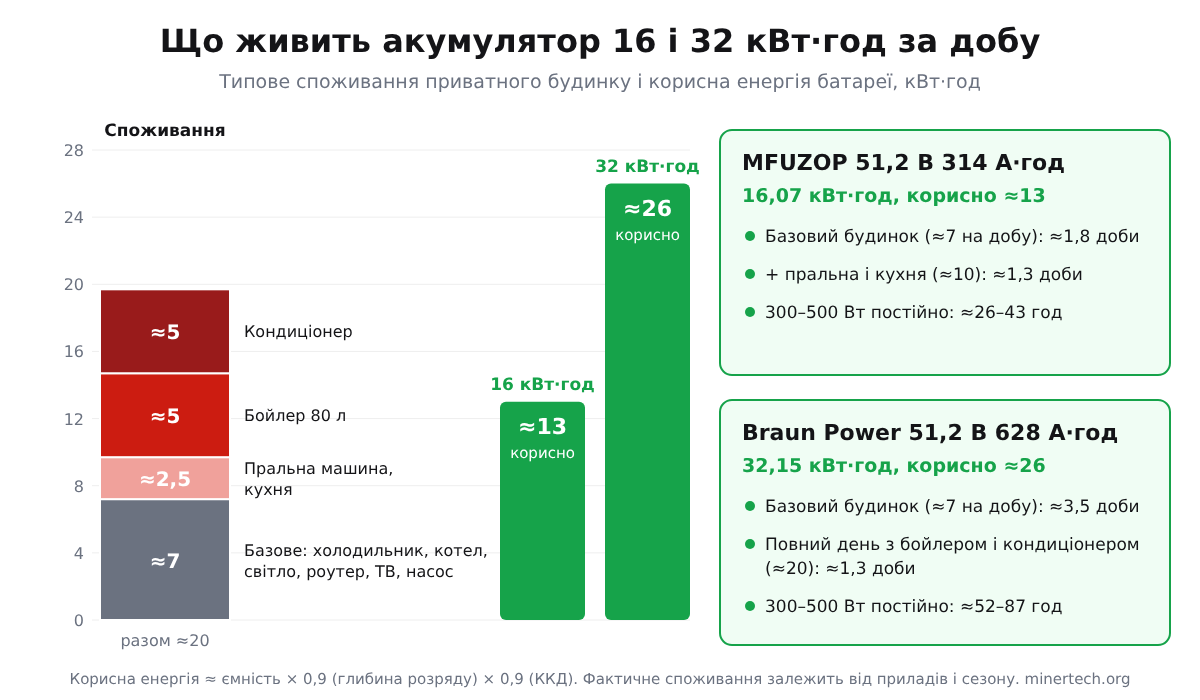
We calculate usable energy conservatively: capacity × 0.9 (depth of discharge) × 0.9 (inverter efficiency). For 16 kWh that is about 13 kWh at the sockets, for 32 kWh about 26 kWh.
A house’s basic consumption (fridge, gas boiler with pump, lighting, router, TV, well pump) is roughly 7 kWh a day. An 80 l water heater and an air conditioner each add a few more kilowatt-hours. So 16 kWh covers a basic day with a margin, while 32 kWh lets you live as usual with a water heater and air conditioner.
MFUZOP 51.2V 314Ah: 16 kWh in one housing
The 16.07 kWh MFUZOP 51.2V 314Ah battery holds as much energy as three typical 5 kWh 48-volt batteries, but without extra connections. Grade A 314 Ah LiFePO4 cells, a service life of at least 8,000 cycles to 70% capacity. The 200 A BMS with CAN, RS485 and RS232 communication sends the state of charge to the inverter; the housing has a colour display showing charge, voltage and temperature, where the inverter protocol is selected (Pylon, Deye, Growatt, Voltronic, Victron, SRNE and others).
The standard discharge current is 157 A, which means a sustained output of about 8 kW, and briefly up to 200 A (≈10 kW). There is a dry contact that can send an alarm signal or start a generator automatically. At an average load of 300–500 W the charge lasts roughly 26–43 hours.
Braun Power 32 kWh: several days of backup
The 32.15 kWh Braun Power 51.2V 628Ah is a storage unit in a metal cabinet on wheels for 48 V systems. Continuous charge and discharge current of 200 A (about 10 kW), active cell balancing at up to 2 A, a service life of 8,000+ cycles to 80% capacity. CAN, RS485, Bluetooth and WiFi communication, a 5-inch touchscreen. At a load of 300–500 W the charge lasts about 52–87 hours, that is 2–3.5 days. This is a solution for a large house, a shop or a site where the generator should be started as rarely as possible.
DATOU BOSS 51.2V: capacity in modules
If your budget or space does not allow a large battery straight away, the system can be built up from 5.12 kWh DATOU BOSS 51.2V 100Ah modules. Three such batteries in parallel give 15.36 kWh, and up to 15 units are allowed in total. Each one’s BMS is rated at 100 A, so two or three batteries in parallel also increase the sustained output. Series connection of these batteries is not allowed.
| Battery | Energy | Sustained output | Parallel | Weight |
|---|---|---|---|---|
| DATOU BOSS 51.2V 100Ah | 5.12 kWh | up to ≈5.1 kW (comfortably up to 2.5 kW) | up to 15 units | compact module |
| MFUZOP 51.2V 314Ah | 16.07 kWh | ≈8 kW (up to 10 kW briefly) | up to 15 units | ≈113 kg |
| Braun Power 51.2V 628Ah | 32.15 kWh | ≈10 kW | up to 16 cabinets | ≈236 kg |
Compatibility with 48 V inverters
A large battery needs an inverter that can make use of it. What matters here is the voltage (48 V), the BMS communication protocol and the current.
- POWGROW SMS-6.5KP 6.5kW 48V and EASUN SMS-6.5KP 6.5kW 48V WiFi. The full 6.5 kW from the battery is about 130 A, so a BMS of 150 A or more is needed. MFUZOP and Braun Power meet this condition with a margin. Charging up to 120 A from the sun and the grid, panel input up to 9,000 W.
- GSIKE 11kW 48V WiFi. To really get 11 kW from the battery, a current of over 200 A is needed. One MFUZOP gives about 8 kW continuously, one Braun cabinet about 10 kW. For the inverter’s full power from the battery we install two batteries in parallel. Charging up to 160 A, two MPPTs of 5,500 W each, a second output of up to 5.5 kW for secondary loads.
The battery’s communication protocol is set for the specific inverter so that it sees the real state of charge rather than relying on voltage alone. See other models in the inverters and batteries sections.
Parallel connection: the rules
- Connect in parallel only identical models of the same capacity, preferably from the same batch.
- Before connecting, charge all batteries to the same level.
- Make the power cables from each battery to the busbar the same length and cross-section, and fit a DC breaker or fuse for each battery. For the MFUZOP the parallel cable and DC breaker are usually bought separately; the Braun Power comes with a parallel cable.
- The batteries are linked with a communication cable, and as a rule the master battery “talks” to the inverter.
Placing a large battery
Both large batteries have IP20 protection and are installed indoors only. The MFUZOP (453 × 260 × 879 mm, about 113 kg) stands on wheels and is fixed to the wall with the bracket supplied. The Braun Power cabinet, weighing about 236 kg, is placed on a level concrete floor and secured with adjustable feet. LiFePO4 can be charged at temperatures from 0 °C, so an unheated garage or shed is not suitable in winter: a boiler room, utility room or dry basement is better. The inverter is placed nearby so that the power cables are short.
Important
Currents in a 48 V system of 8–11 kW reach 150–220 A. The cable cross-section, DC protection and connection to the house distribution board are calculated and carried out only by a qualified electrician. Read how to group the circuits and where to leave room for the backup in the article on the distribution board for a private house.
A large battery and solar panels
You get the most benefit from 16–32 kWh together with photovoltaics. By our calculation for London, one 5 kW array of solar panels produces on average about 13 kWh a day: 20 in summer and only about 5 in December (details in the article on 5 kW panel output). So in summer one array almost fully charges a 16 kWh battery in a day, while for 32 kWh two arrays make sense, as with the GSIKE 11 kW with two MPPTs. In winter a large battery charges mainly from the grid, and here the inverter’s high charging current helps: from the grid, an MFUZOP at the recommended current of 60–100 A charges from almost zero in roughly 3.5–5 hours.
Frequently asked questions
Which is better: one 16 kWh battery or three of 5 kWh?
One large battery is simpler to install and has fewer connections. Modules are convenient if you want to start with a smaller sum and expand gradually.
Can 32 kWh be used with a 24 V inverter?
No. MFUZOP, Braun Power and DATOU BOSS 51.2V are designed for 48 V systems.
Will a large battery replace a generator?
For most outages, yes. For multi-day failures the generator is kept as a standby source, and the MFUZOP can start it through a dry contact. We described the automatic start scheme in the article on a generator with ATS.
Expert opinion
Large capacity is justified when you know your daily consumption precisely and understand where the battery will be charged from. Without solar panels and with short outages, 32 kWh often has time neither to discharge nor to pay for itself, and it is wiser to take 16 kWh. But in a house with long outages or with a solar station of 10 kW or more, a large battery turns backup power into almost independent energy supply. We bring all equipment from Europe, give a 1-year warranty and have already delivered more than 1000 off-grid systems.
Call us, and an engineer will calculate a system for your house, select the inverter and battery and arrange turnkey installation in Dnipro and the region: 093 293 93 93, 099 054 40 38.