
Connecting a generator for automatic operation
The power goes out at three in the morning, the generator is in the shed, and you have to go and start it, flip the changeover switch, and then stop it the same way when the grid comes back. Sound familiar? A generator can be taught to do all this by itself. You need three things: a generator with an electric starter and an auto-start input, an ATS controller and a power section built on interlocked contactors. After that, the house switches to the generator on its own and returns to the grid on its own.
Who needs it
- A private house where outages are long and there is nobody to run out to the generator at night.
- A house where elderly people or children live, and the boiler, borehole pump and fridge must work without anyone’s involvement.
- A shop, pharmacy, car service centre or small workshop: even half an hour of downtime costs money.
- Owners of a battery + inverter kit whose battery is not enough for a long blackout: the generator starts automatically and tops up the battery.
What the generator must be able to do
Not every generator can be switched to automatic mode. Check three points:
- An electric starter and a 12 V battery. A model with only a manual pull starter will not start automatically.
- An auto-start input. This is the ATS socket on the generator panel or remote start terminals. Through it the controller sends “start” and “stop” commands. In catalogues such models are listed as “with ATS socket” or “automation-ready”.
- An automatic choke. This matters for petrol models: if the choke has to be closed by hand, a cold engine may not start automatically. Check this in the generator manual.
Think separately about the starter battery: the generator may stand in standby mode for weeks. To make sure the battery is not flat at the critical moment, it is kept on charge from the grid. Some controllers and ATS units can do this themselves; otherwise a separate 12 V charger is fitted.
How the automation works
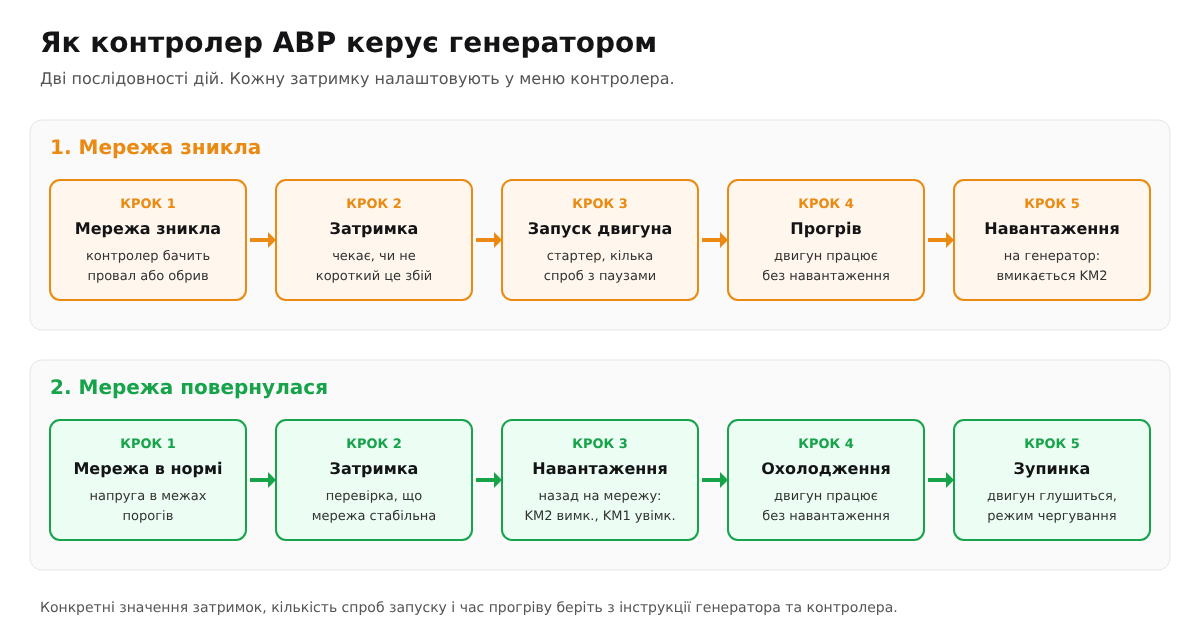
The ATS controller constantly monitors the grid voltage. Its job is not only to switch the load, but also to start and stop the engine correctly.
The grid goes down. The controller does not react instantly: first it waits out a delay so as not to start the engine on every brief dip. Then it sends a command to the starter. If the engine does not start, it pauses and tries again, and after several failed attempts it raises an alarm. Once the engine is running, it is allowed to warm up without load, and only then does the generator contactor switch on.
The grid comes back. The controller waits again to make sure the voltage is stable. Then it moves the load to the grid, while the engine keeps idling for a while to cool down and only then stops. The generator returns to standby mode.
All these delays are set in the controller menu. Take the specific values from the generator and controller manuals.
Power circuit: interlocked contactors
The load is switched by two contactors: KM1 connects the house to the grid, KM2 to the generator. The controller drives their coils and also sends the start command to the generator.
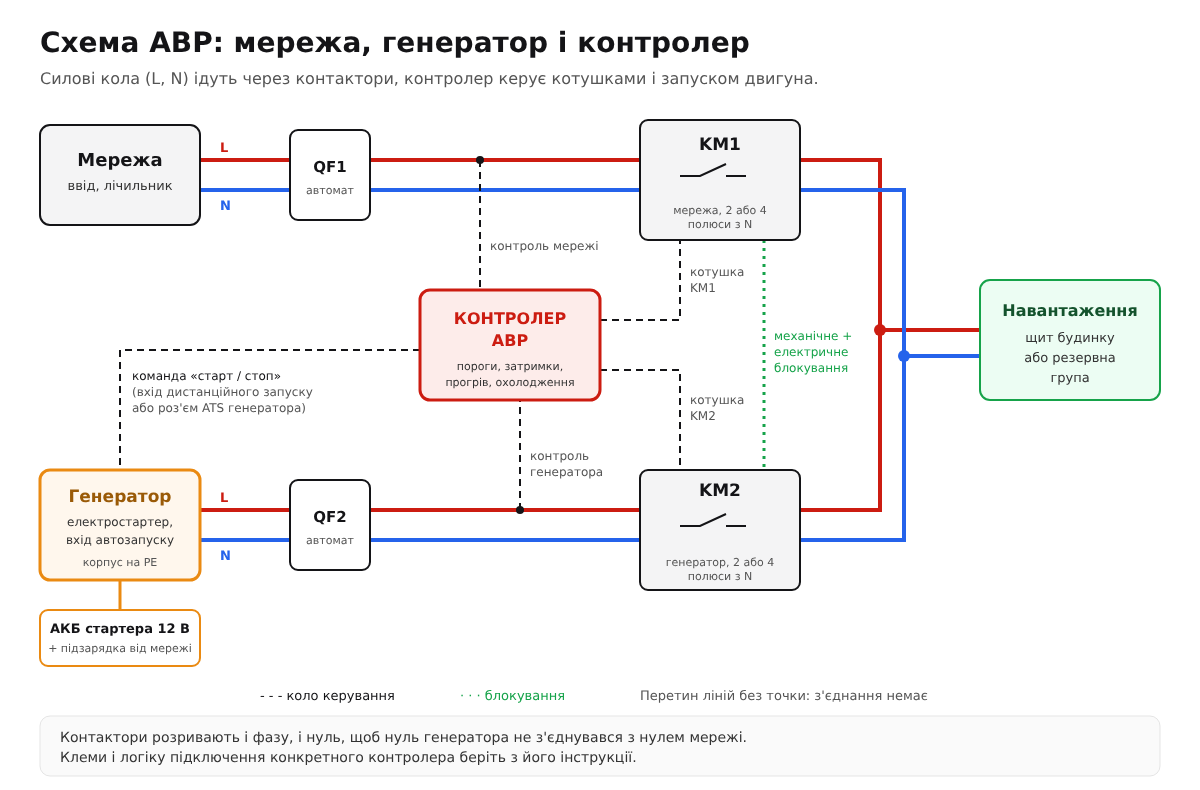
Double interlocking. If KM1 and KM2 close at the same time, the generator is connected to the grid. That means damage to the generator and danger for electricians on the line. That is why two levels of protection are fitted: electrical interlocking (a normally closed auxiliary contact of one contactor in the coil circuit of the other) and mechanical interlocking (a separate module that physically prevents both contactors from closing). Instead of a pair of contactors, you can fit a ready-made motorised ATS switch.
Neutral and earthing. The contactors must switch both the phases and the neutral: 2 poles for a single-phase supply, 4 poles for a three-phase one. This way the generator neutral is not connected to the grid neutral, and voltage cannot reach the line through the neutral wire. The generator housing is connected to the house’s protective conductor PE or to the earthing system. How the neutral and the housing are connected inside a particular generator is stated in its manual. This determines whether the RCDs will work correctly in generator mode, so they must be checked with the “TEST” button while running on the generator.
Three-phase generator. For example, the manufacturer Könner & Söhnen explicitly warns that the 400 V output of its three-phase models with ATS is intended for three-phase loads, not for powering the whole house. So before connecting a three-phase generator, read carefully how the manufacturer allows the load to be distributed across the phases.
How to size the generator for the load
- Make a list of the loads that will run from the generator and add up their power.
- Allow for starting currents. Pumps, fridges, compressors and air conditioners draw several times their rated power at start-up. The total starting surge must fit within the generator’s maximum power.
- Go by the rated power, not the maximum. The maximum is only allowed for short periods.
- Leave a margin. A generator that constantly runs at its limit wears out faster and holds the voltage less well.
- Do not connect everything. The water heater, electric cooker and oven are often left off the generator: make a separate group for the generator, just as for an inverter.
A generator together with a battery + inverter kit
The most comfortable solution for a house is a generator combined with a battery + inverter kit. The ATS output (grid or generator) is fed to the inverter’s AC input. Critical loads are powered from the inverter output, while powerful loads can be fed directly from the ATS.
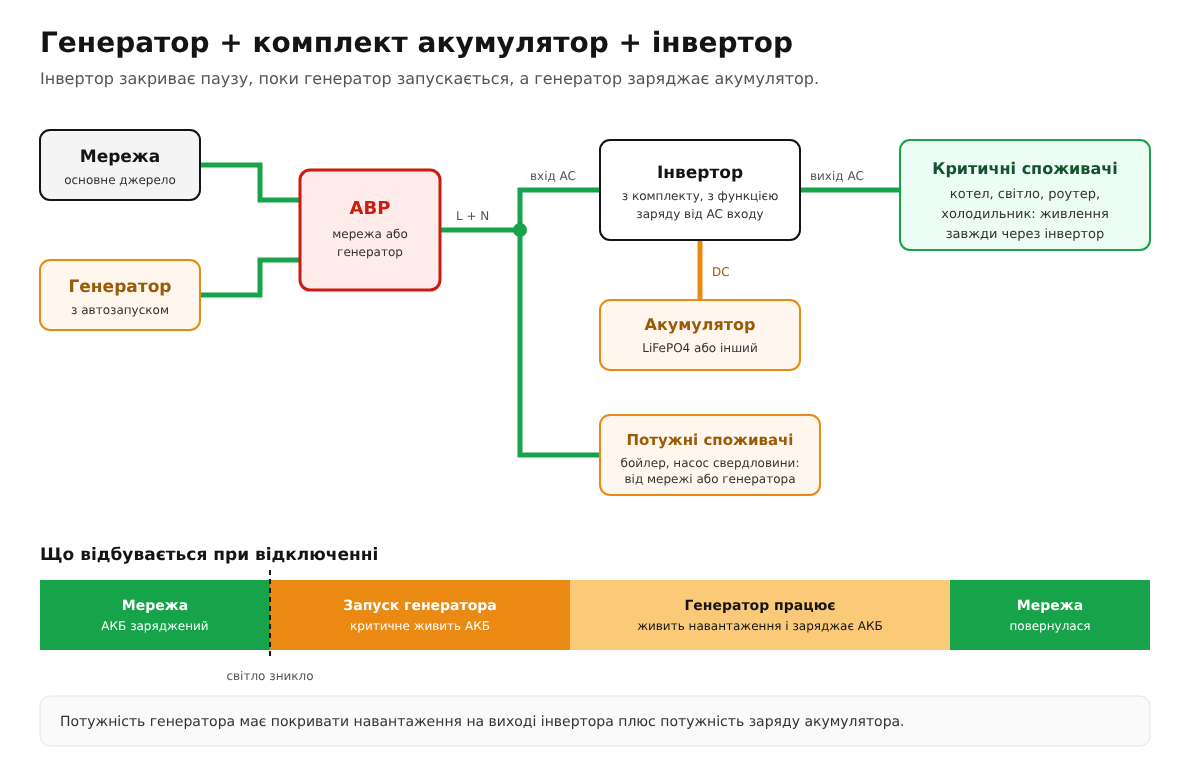
- While the generator starts and warms up, the critical loads run from the battery. You do not even notice the pause.
- Once the generator is up to speed, the inverter powers the load from it and charges the battery at the same time.
- The generator can be started less often and for shorter periods: some hybrid inverters can themselves send the generator start command when the battery charge falls to a set level. Check the inverter manual to see whether it has this feature.
When choosing the generator’s power, add the battery charging power to the load on the inverter output. Otherwise, the moment the inverter starts charging the battery, the generator will be overloaded.
Which devices are suitable
| Device | What it can do | When to choose |
|---|---|---|
| Datakom DKG-309 | AMF (automatic mains failure) controller for one standby generator or two generators in mutual standby. MPU and CANBUS versions, IP65 front panel | Diesel or gas generator, home or business |
| Deep Sea DSE6120 MKIII | AMF module for one diesel or gas generator, monitoring of three grid and generator phases, PC configuration | Stationary generators with their own control panel |
| SmartGen HGM6120N | Grid monitoring and automatic grid / generator switching, starter control with several attempts. Suffix N: without RS485 and CAN ports | An affordable controller for a generator with an electric starter |
| Könner & Söhnen KS ATS 4/32-12, 4/32-15 | ATS unit that starts the generator when the grid fails and stops it once power is restored. 230/400 V, 50 Hz, operation from −10 to +55 °C | Könner & Söhnen generators with an ATS socket |
| Hager HIC406A | Modular motorised ATS switch I-0-II, 4 poles, 63 A | A power section instead of a pair of contactors |
| Schneider TeSys D contactors + LAD9V2 unit | Mechanical interlock for LC1D09–D38 contactors in source-changeover circuits | Your own ATS assembly in the board |
The data is taken from manufacturers’ descriptions and distributors’ catalogues. Voltage thresholds, delay ranges and terminal layouts differ between models, so check the manual of the specific controller and generator before installation.
How to do it: step by step
- Check the generator. Electric starter, auto-start input or ATS socket, automatic choke, a healthy 12 V battery.
- Work out the load. Separate the group the generator will power, taking into account starting currents and, if present, the kit’s battery charging.
- Choose the automation. A branded ATS unit for your generator, a universal AMF controller or a ready-made motorised ATS switch.
- Assemble the power section. Contactors KM1 and KM2 rated for the load current with a margin, with electrical and mechanical interlocking and neutral switching. Breakers on both inputs.
- Run the cables. A power cable from the generator of the right cross-section, a control cable to the auto-start socket, earthing of the generator housing.
- Prepare a place for the generator. A ventilated spot with exhaust extraction, protection from rain and snow, away from windows and doors.
- Set up the controller. Grid voltage thresholds, start delay, number of attempts, warm-up time, return delay and cool-down.
- Test it in operation. Switch off the main breaker and follow the whole cycle: start, warm-up, switchover. Switch the grid back on and make sure the load has returned and the generator has cooled down and stopped. Check the RCDs in both modes.
Safety first
Never connect a generator to the wiring through a socket with a two-plug cable: the voltage will go into the grid, where people may be working, and the generator will fail when the power comes back. A generator is connected only through an ATS or an interlocked changeover switch. Do not place the generator in an enclosed room: exhaust gases are deadly. Remember that a generator in standby mode may start at any moment, so before servicing switch the controller to manual mode or turn it off. Work in the board is done by a qualified electrician.
Expert opinion
An automatic generator takes away the main hassle of long outages: you do not have to start or switch anything, it all happens by itself. But a generator on its own always gives a pause for starting and warming up, and it is also noisy, burns fuel and needs maintenance. That is why the best solution for a house is a generator together with a battery + inverter kit: short outages are covered by the battery and the generator does not even start, while during a long blackout it starts automatically, powers the house and charges the battery. Meanwhile, the boiler and router run from the inverter and barely notice the change of source.
Want to set up your generator for automatic operation or combine it with a kit? We do turnkey installation in Dnipro. Call us: 093 293 93 93, 099 054 40 38. MinerTech engineers will advise on your specific task.