
Turnkey installation of backup power and solar panels in Dnipro
Turnkey installation means you get not boxes of equipment but a ready-made backup power system: an inverter and battery matched to your consumption, connected to the distribution board and set up to work as one. When the power goes out, your apartment or house switches to the battery automatically, with no manual switching at all. Here is what stages this work involves in Dnipro and the region, what to prepare in advance and which mistakes to avoid.
What turnkey installation includes
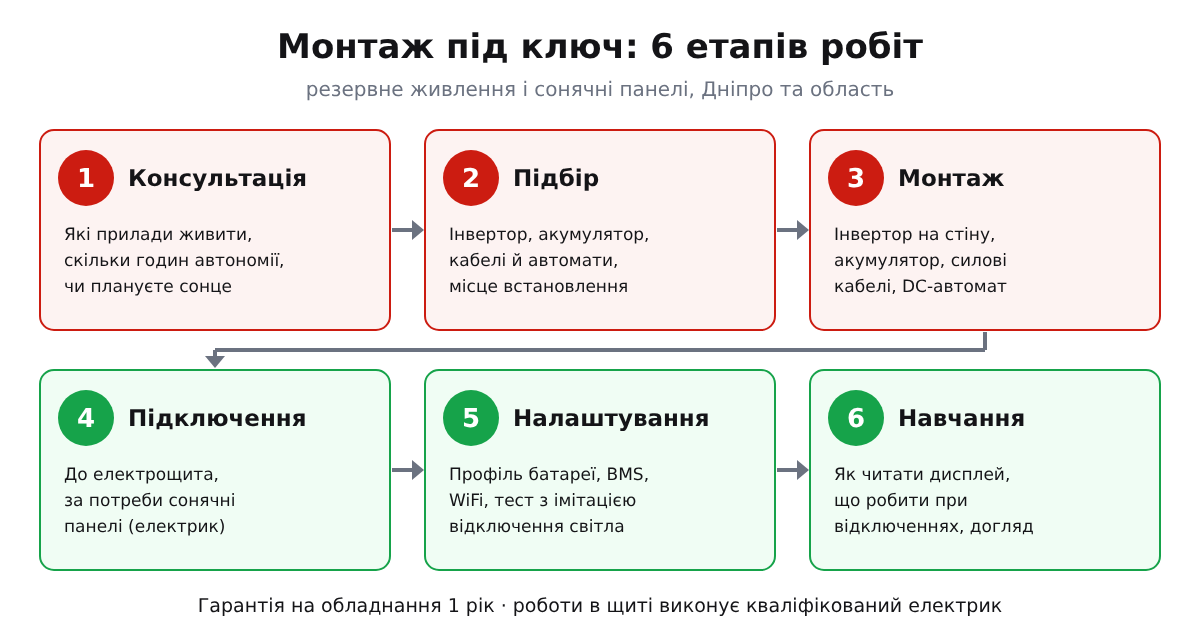
On a turnkey basis we install a battery + inverter kit for an apartment, private house or office, and if you wish we add solar panels straight away. The whole job is divided into six consecutive stages, and at each one you know what is happening and why.
Stages of backup power installation
1. Consultation. We discuss which appliances must work during a power cut: the boiler, fridge, pump, router, lighting, kitchen appliances. We determine the backup time you want and whether you are planning a solar station now or in the future. Both the inverter power and the battery capacity depend on this.
2. Equipment selection. We select the inverter, LiFePO4 battery, cables and circuit breakers to match your consumption. We choose the installation location straight away, taking into account ventilation, safety and cable length: the closer the battery is to the inverter and the inverter to the board, the lower the losses. Ready-made pairs can be found in the battery + inverter kits section.
3. Installation. We mount the inverter on the wall, install the battery, run the power cables and fit the circuit breakers. A DC breaker or fuse is always fitted in the positive wire between the battery and the inverter, and the terminal bolts are tightened firmly, because a loose contact heats up.
4. Connection to the board. We connect the system to the house or apartment wiring and, if needed, the solar panels too. Work in the distribution board is done only by a qualified electrician. We covered how to organise the board properly in detail in our guides distribution board for a house and distribution board for an apartment.
5. Setup. We set up the inverter for the type and parameters of your specific battery, communication with the BMS and WiFi monitoring. Then we test the system with a simulated power cut: we switch off the grid input and watch the load switch to the battery.
6. Training. We show you how to read the display, what to do during outages and how to look after the system. After that you can use your backup power on your own with confidence, and if questions come up, we will help after installation too.
What the customer should prepare before installation
To make the consultation and selection quick and avoid surprises on site, prepare a few things:
- A list of appliances that must work without grid power, ideally with their power ratings from the labels or manuals.
- The backup time you want: a few hours of an evening outage or a whole night.
- A close-up photo of the distribution board showing the breakers, and whether you have one phase or three.
- A place for the equipment: a dry, ventilated room, ideally next to the board. A bathroom or a cold balcony is not suitable, because lithium batteries are charged at above-zero temperatures.
- Your solar plans: if you are thinking about solar panels, photos of the roof or plot and its orientation to the points of the compass. For the tilt angle, read our guide how to choose the panel installation angle.
- Access to the board on installation day and the possibility of switching off the power briefly for the connection.
Typical DIY installation mistakes
Most problems with backup power systems are caused not by the equipment but by installation mistakes. Here is what most often happens with DIY installation:
| Mistake | What it leads to |
|---|---|
| Thin cables between the battery and inverter | Heating, voltage drop, the inverter shuts down under load |
| Poorly tightened terminals | The contact heats up and the lugs melt |
| No DC breaker or fuse | Nothing to break the circuit in a short circuit |
| Wrong charge settings, a lead-acid profile for LiFePO4 | The battery is undercharged or runs in a harsh mode and lasts less |
| BMS communication not set up | The inverter does not see the real state of charge |
| Mistakes in the board, no earthing | Danger to people and equipment |
A separate note on power: continuous output from the battery is limited by its BMS current. For example, with a DATOU BOSS 25.6V 314Ah 8.03kWh battery (150 A BMS), a 24 V system can deliver about 3.8 kW continuously, even if the inverter is rated for 5 kW. We take such nuances into account already at the selection stage.
Important
Connection to the distribution board and any work on the incoming supply are done only by a qualified electrician. Currents in the battery circuit can reach 100–200 A or more, so cable cross-sections and breaker ratings are calculated, not chosen “by eye”.
Installing solar panels together with the inverter
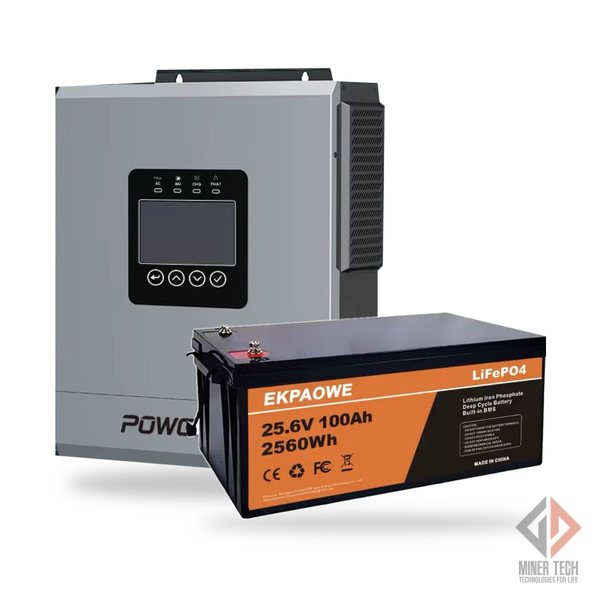
Most hybrid inverters we install have a built-in MPPT controller, so solar panels can be connected straight away or added later without replacing the inverter. For example, the POWGROW SMS-5kW 24V + EKPAOWE 25.6V 100Ah kit accepts panels with a voltage of 60–450 V. For photovoltaics we choose the number of panels in a string to suit the inverter input: for example, Tadiran TD630 630 W panels weigh about 34 kg and are 2.4 m long, so they are installed by two people on a sturdy structure. See other models in the solar panels section.
Warranty and support
We bring all equipment from Europe, and the goods carry a 1-year warranty. Our team is made up of electronics engineers with more than 1000 off-grid systems delivered, so we know the specifics of every inverter and battery model we sell from practice. The scope of work depends on the site, so before installation we always agree on the wiring diagram and the installation location.
Frequently asked questions
Does anything need to be switched off in the house during installation?
Yes, the power is briefly switched off while connecting to the board. The rest of the work is done without cutting the power.
Can I install a kit first and add solar panels later?
Yes, if the inverter is a hybrid with an MPPT controller. We will take this into account straight away when selecting the equipment and the installation location.
Can I monitor the system from my phone?
Yes, if the inverter has WiFi monitoring. During setup we connect it and show you where to check the battery charge and energy flows.
How long does installation take?
It depends on the site and the complexity of the board. We agree the timeline after the consultation and seeing a photo of the board.
Why is turnkey installation better than a plug-in uninterruptible power supply (UPS)?
A battery + inverter kit connected to the board powers the required circuits of the house automatically, without extension leads or manual switching.
Expert opinion
Good equipment only shows what it can do when it is installed correctly. Cables of the right cross-section, tightly fastened terminals, a breaker in the positive wire and charge settings for your specific battery decide whether the system will serve for years without problems. That is why we recommend leaving installation to professionals and doing yourself only what is safe: preparing the list of appliances, the location and a photo of the board.
Want backup power or a turnkey solar station in Dnipro or the region? Call us: 093 293 93 93 or 099 054 40 38. We will select the equipment, agree the scheme and install a system that simply works.