
EcoFlow or a battery + inverter kit: which is better value?
EcoFlow power stations have become almost a synonym for backup power: everyone knows them, they look good, they are compact and work “out of the box”. But does it make sense to buy one if the station will stand at home and power the boiler, fridge and router during outages? We compared prices for every kilowatt-hour of capacity and every kilowatt of power, and the difference turned out to be much bigger than people usually expect.
What we are comparing
A power station (EcoFlow and similar) is a battery, inverter, charger and solar controller in a single portable case. A battery + inverter kit consists of the same parts, but as separate units: a pure sine wave hybrid inverter and a lithium battery, permanently connected to the electrical wiring of an apartment or house.
To keep the comparison fair, we calculate two simple values:
- price per 1 kWh of rated capacity: how much energy you buy for your money;
- price per 1 kW of rated power: which appliances you can run at the same time.
For EcoFlow we take the official specifications and the median price of new units across shops on hotline.ua, plus the official shop or dealer price where available. For the kits we take prices from our catalogue. All prices are as of 11 October 2026.
Prices and specifications
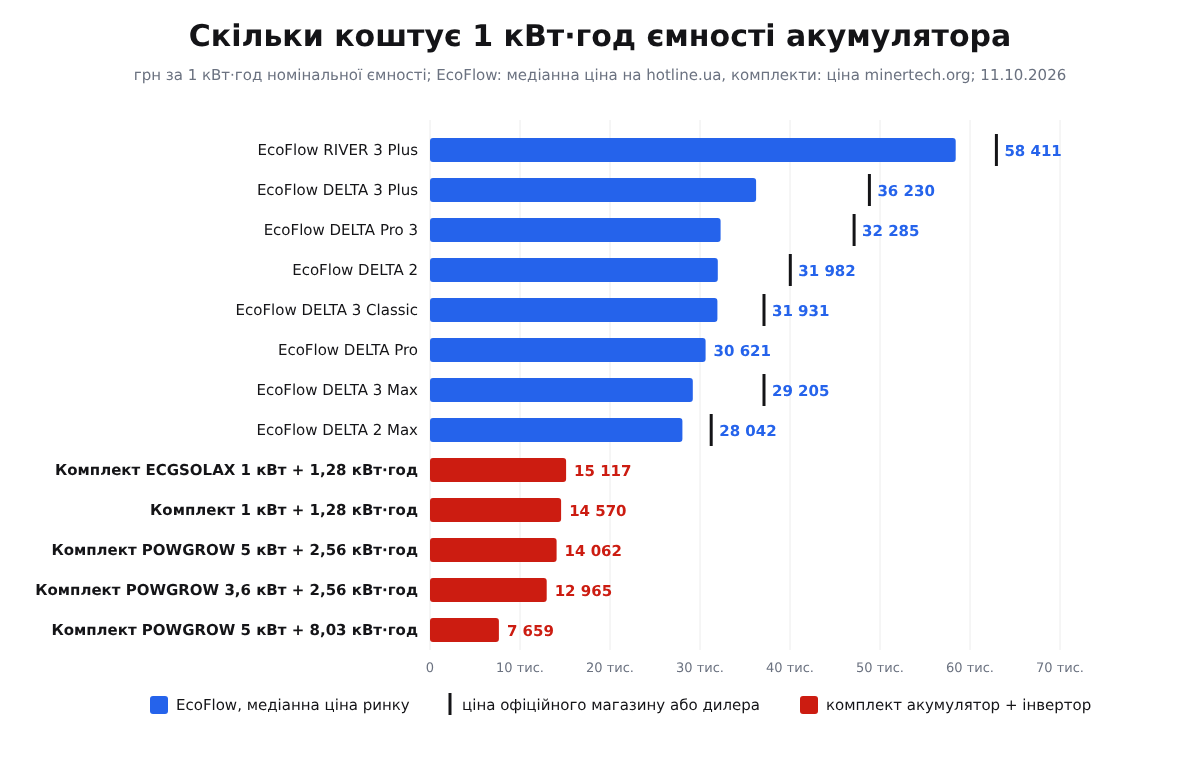
| Model | Capacity / power | Price, UAH | UAH per 1 kWh |
|---|---|---|---|
| EcoFlow RIVER 3 Plus | 0.286 kWh / 600 W | 16,706 (official shop 17,999) | 58 411 |
| EcoFlow DELTA 3 Classic | 1.024 kWh / 1800 W | 32,698 (official dealers 37,999) | 31 931 |
| EcoFlow DELTA 2 | 1.024 kWh / 1800 W | 32,750 (official dealer 40,999) | 31 982 |
| EcoFlow DELTA 3 Plus | 1.024 kWh / 1800 W | 37,100 (official shop 49,999) | 36 230 |
| EcoFlow DELTA 2 Max | 2.048 kWh / 2400 W | 57,431 (official dealer 63,999) | 28 042 |
| EcoFlow DELTA 3 Max | 2.048 kWh / 2400 W | 59,812 (official shop 75,999) | 29 205 |
| EcoFlow DELTA Pro | 3.6 kWh / 3600 W | 110 237 | 30 621 |
| EcoFlow DELTA Pro 3 | 4.096 kWh / 4000 W | 132,241 (official shop 192,999) | 32 285 |
| Kit 1 kW + 12.8 V 100 Ah | 1.28 kWh / 1000 W | 18 650 | 14 570 |
| Kit ECGSOLAX 1 kW + POWINVER 12.8 V 100 Ah | 1.28 kWh / 1000 W | 19 350 | 15 117 |
| Kit POWGROW 3.6 kW + EKPAOWE 25.6 V 100 Ah | 2.56 kWh / 3600 W | 33 190 | 12 965 |
| Kit POWGROW SMS-5kW + EKPAOWE 25.6 V 100 Ah | 2.56 kWh / 5000 W | 36 000 | 14 062 |
| Kit POWGROW SMS-5kW + DATOU BOSS 25.6 V 314 Ah | 8.03 kWh / 5000 W | 61 500 | 7 659 |
Kit capacity is calculated as battery voltage × capacity (for example, 25.6 V × 100 Ah = 2.56 kWh). The EcoFlow price without brackets is the median among offers for new units on hotline.ua; the price in brackets is from the “Ecoflow Ukraine” shop or a seller marked as an official dealer on the same site. Prices change daily, so check the current ones before buying.
Price per kilowatt-hour: a 2–4× difference
A kilowatt-hour in DELTA series stations costs 28–36 thousand UAH at market prices and up to 49 thousand UAH at the official shop’s recommended prices. In kits it costs 7.7–15 thousand UAH. The bigger the system, the more noticeable the difference: a large battery in a kit costs less per kilowatt-hour, whereas in a power station the price per kilowatt-hour barely falls with size.
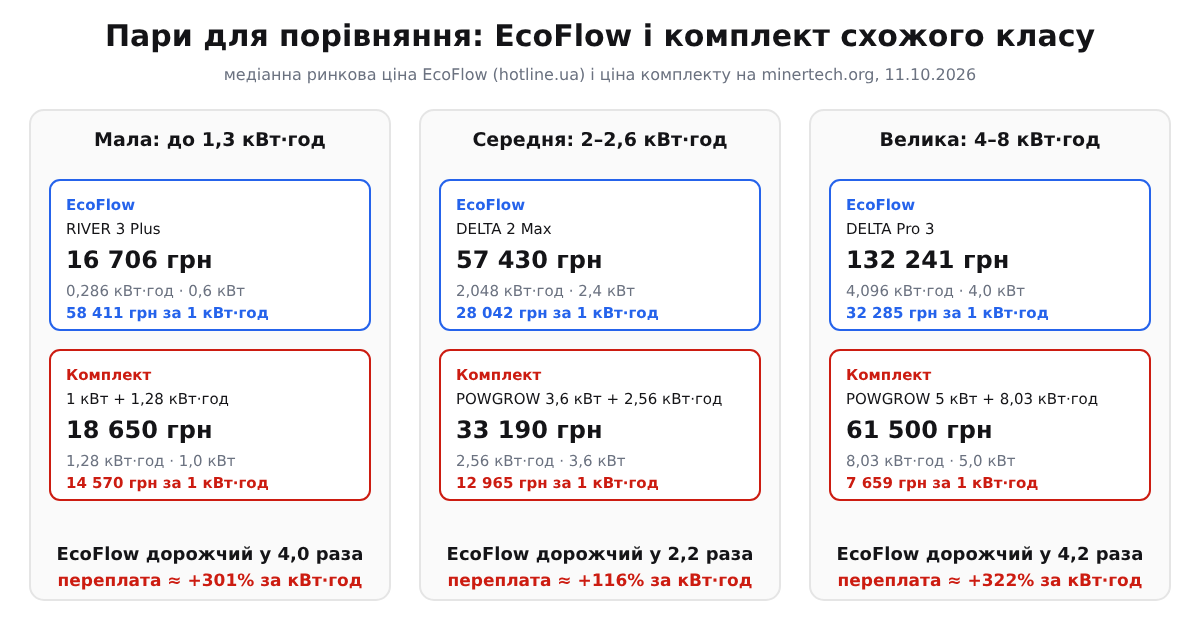
Pairs of a similar class: the real overpayment
| Pair | How many times more expensive per kWh | Overpayment |
|---|---|---|
| RIVER 3 Plus versus a 1 kW + 1.28 kWh kit | 4,0 | ≈ +300% |
| DELTA 3 Classic versus an ECGSOLAX 1 kW + 1.28 kWh kit | 2,1 | ≈ +110% |
| DELTA 2 Max versus a POWGROW 3.6 kW + 2.56 kWh kit | 2,2 | ≈ +115% |
| DELTA Pro 3 versus a POWGROW 5 kW + 8.03 kWh kit | 4,2 | ≈ +320% |
On average across these four pairs, the overpayment per kilowatt-hour is about 200%, which means that for the same capacity in a power station you pay roughly three times as much. For 1–2 kWh systems the overpayment is closer to 110–120%, and for large systems it exceeds 300%. If you buy at the official shop’s recommended prices, the difference is even bigger: for example, a DELTA Pro 3 at 192,999 UAH works out at 47 thousand UAH per kilowatt-hour, 6 times more than a large kit.
Look at the absolute amounts too: the POWGROW 3.6 kW + 2.56 kWh kit costs 24 thousand UAH less than the DELTA 2 Max, even though it has more capacity and 1.5 times the power. And the large 8.03 kWh kit costs half as much as the DELTA Pro 3 with almost twice the capacity.
Price per kilowatt of power
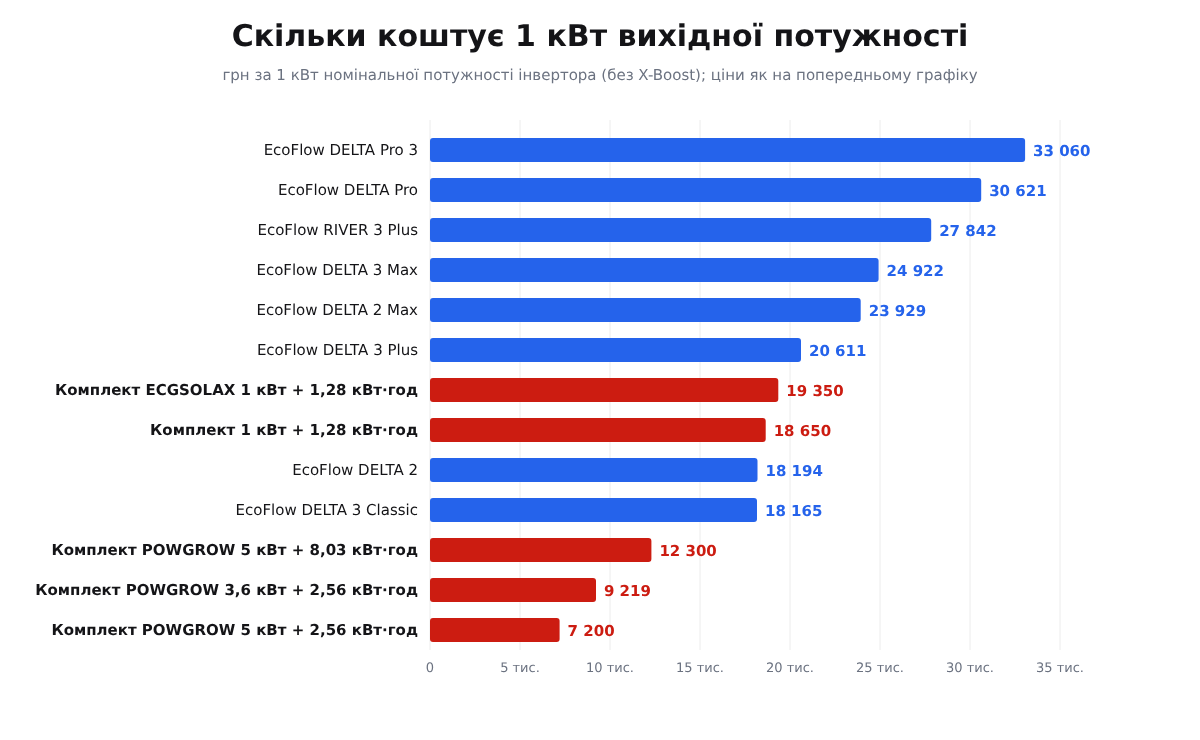
Here, honestly, the picture is mixed. Small 1 kW kits are roughly on a par with the DELTA 2 and DELTA 3 Classic in price per kilowatt of power (≈18–19 thousand UAH per kW). The kits’ advantage appears from 3.6 kW upwards: 7.2–9.2 thousand UAH per kilowatt versus 24–33 thousand UAH for EcoFlow’s higher models. It is power that determines whether the system can handle an electric kettle, microwave, borehole pump or water heater at the same time as the fridge.
The honest advantages of each option
| EcoFlow power station | Battery + inverter kit |
|---|---|
| Works straight out of the box, without an electrician and without touching the wiring | Each kilowatt-hour of capacity is 2–4 times cheaper |
| Portable: you can take it to the country house, in the car, on a trip or to a shelter | More power: 3.6–5 kW in mid-range kits |
| A neat, compact case, a convenient app, a well-known brand with a wide sales network | Connects to the board: powers sockets, the boiler and lighting throughout the apartment, switching to battery in about 10 ms |
| Suits tenants and those who are not allowed to touch the wiring | Easy to expand: add a battery or solar panels (hybrid inverters have a built-in MPPT controller) |
| Built-in sockets, USB and a car output | Repairability: the inverter and battery are separate, so if something breaks only one part is replaced |
There are downsides too. A kit has to be installed (breakers, cables and the electrician’s work should be added to its price), it takes up space on a wall or the floor and is not meant to be carried around. A power station, in turn, is limited by the power of its inverter and its own capacity, and expanding it with branded extra batteries is not cheap either.
How to choose: step by step
- Decide what needs powering. A router, lights and a laptop: 0.3–1 kWh is enough. A boiler, fridge, pump: from 2 kWh. An evening and night without power for a house: from 5 kWh.
- Work out the power. Add up the power of the appliances that will run at the same time and add a margin. From 2 kW upwards, kits are much better value.
- Decide whether you need mobility. If the device will travel with you, choose a power station. If it will stay at home, a kit gives you more for the same money.
- Think about solar panels. If you plan to add them, choose a hybrid inverter with the right panel voltage range.
- Compare the full cost. Add installation to the kit price, and extra batteries to the station price if the capacity is not enough. Calculate the price per kilowatt-hour as in the table above.
Safety first
A stationary inverter is connected to the distribution board, so installation must be done by a qualified electrician with the right breakers and cable cross-sections. Do not connect either a power station or an inverter to the home network “plug to plug”: without proper switching, the energy can flow into the external grid and endanger electricians repairing the line.
Expert opinion
EcoFlow makes quality equipment, and it is perfectly reasonable to pay more for mobility, design and “out of the box” simplicity. But if the station will stand at home and power the boiler, fridge and router during outages, you are overpaying for a brand and a portable format you do not use. By our calculations this overpayment averages about 200% per kilowatt-hour, and for large systems it exceeds 300%. That is why for stationary backup we recommend battery + inverter kits: they are cheaper, more powerful and easy to expand. We have delivered 1000+ off-grid systems, bring equipment from Europe and give a 1-year warranty.
Not sure what to choose for your apartment or house, or need a turnkey installation in Dnipro? Call us: 093 293 93 93, 099 054 40 38. MinerTech engineers will select a kit for your appliances.