
Three-phase backup power for homes and businesses: a kit of 3 inverters
Most houses and apartments get through power cuts with a single single-phase inverter. But if you have a three-phase well pump, a three-phase electric boiler, a machine tool or a compressor, one phase will not be enough: such loads simply will not start. They need three-phase backup power. Here we explain when it is really needed, how three single-phase inverters together provide a full 400 V and how to choose a LiFePO4 battery for them.
When you need three phases and when one is enough
A three-phase supply to the house does not mean that backup power must also be three-phase. What decides is not the supply but the loads that must work during an outage.
Three phases are needed if the essential equipment includes three-phase motors and appliances:
- well and drainage pumps with a three-phase motor;
- electric boilers and water heaters designed for three-phase connection;
- machine tools, compressors, ventilation and refrigeration equipment in a workshop, shop or small production site;
- sites where the total load is large and it makes sense to spread it evenly over three phases.
One phase is enough if all essential loads are single-phase: a gas boiler, circulation pump, fridge, lighting, router. Then it is simpler and cheaper to build a backup line from one inverter, and an automatic phase switch will protect against voltage problems on individual phases. We covered how to group the circuits properly in the article on the distribution board for a private house.
How three single-phase inverters work in three-phase mode
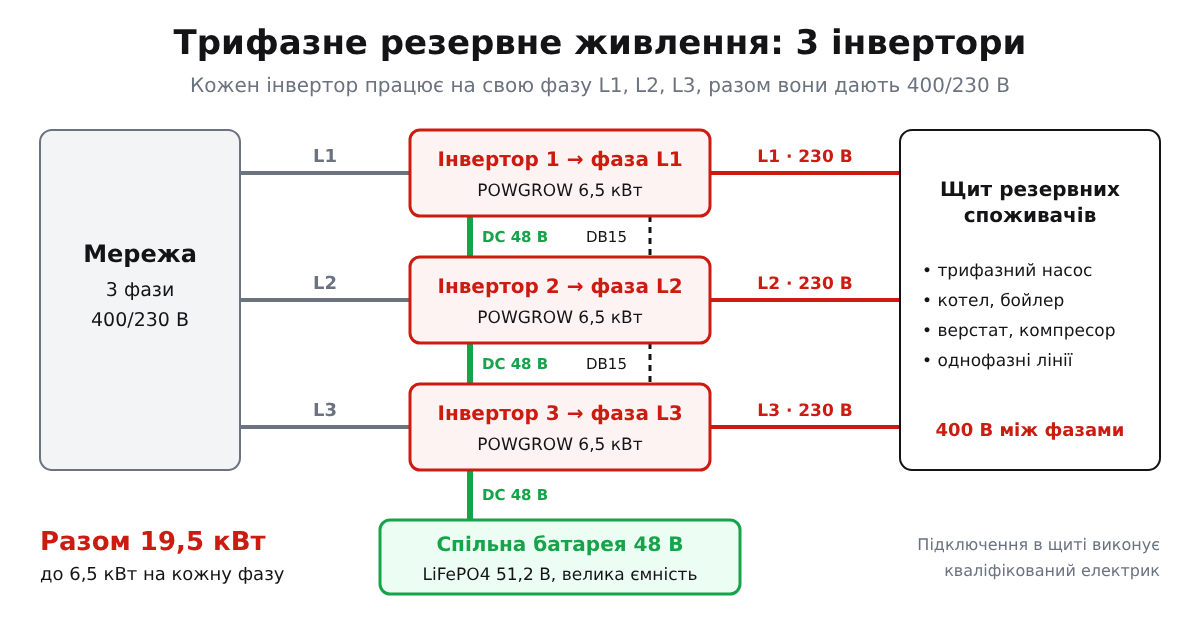
A three-phase grid consists of three phases whose voltages are shifted relative to each other. Between a phase and neutral there are 230 V, between two phases 400 V. To get such a grid from a battery, three identical inverters supporting parallel operation are installed and each is set to its own phase: the first to L1, the second to L2, the third to L3.
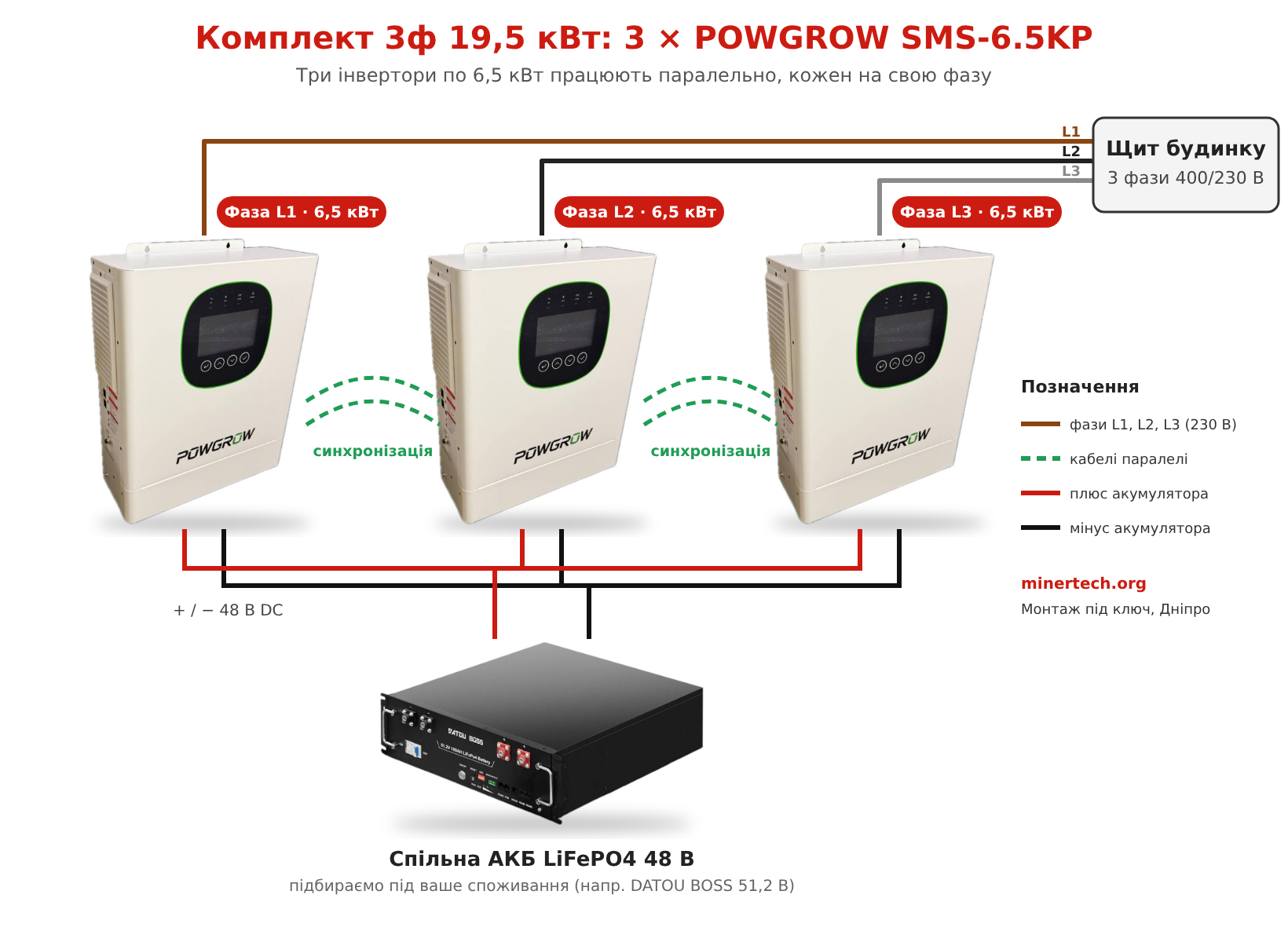
The inverters are linked with synchronisation cables. Through them they constantly “agree” with each other, and each forms its own phase with the correct shift. The output is a full 400/230 V grid that runs both three-phase motors and ordinary single-phase circuits.
What is important to understand:
- Power is divided by phase. Three 6.5 kW inverters give 19.5 kW together, but each individual phase gets no more than 6.5 kW. A 9 kW single-phase water heater will not run from such a system, and single-phase circuits must be spread evenly over the phases.
- Phase imbalance has a limit. If one phase is overloaded, that phase’s inverter goes into protection and the three-phase equipment stops. That is why we plan load distribution at the design stage.
- The battery is shared. All three inverters run from one 48 V battery bank, so energy is spent exactly where the load is.
Three-phase 19.5 kW kit of three POWGROW 6.5 kW inverters
For such tasks we offer the three-phase kit 19.5 kW (3×POWGROW 6.5 kW). These are three POWGROW SMS-6.5KP 6.5 kW 48 V hybrid inverters working in sync, each on its own phase. The DB15 synchronisation cables are supplied with the inverters. The battery is not included in the kit: we select it for your consumption.
| Parameter | Value |
|---|---|
| Contents | 3 POWGROW SMS-6.5KP 48 V inverters, without battery |
| Total power | 19.5 kW (3 × 6,500 W), peak 13 kVA per inverter |
| Output | 3 phases, 400 V phase-to-phase, 230 V phase-to-neutral, pure sine wave |
| Overload (per inverter) | 102–120% up to 10 min, 120–150% up to 1 min, 150–200% up to 10 s |
| Solar input (per inverter) | MPPT 60–450 V, Voc up to 500 V, up to 9,000 W of panels |
| Charging (per inverter) | up to 120 A from the sun and the grid |
| Transfer time | 10 ms |
| Communication | Battery BMS via RS485/CAN to the first inverter, WiFi monitoring |
The overload margin and the 13 kVA peak power per phase help when starting pumps and compressors, where the starting current is several times higher than the running current. For businesses it is also useful that each inverter has its own solar input: the system can be supplemented with solar panels to run partly on the sun during the day.
High-capacity 51.2 V batteries for a three-phase system
19.5 kW needs a battery capable of delivering a high current. At 48 V, the kit’s full power means a current of over 380 A on the battery side. That is why we look not only at capacity in kWh but also at the permissible BMS current.
| LiFePO4 battery | Energy | BMS / sustained output |
|---|---|---|
| DATOU BOSS 51.2 V 100 Ah | 5.12 kWh | 100 A, up to ≈ 5.1 kW |
| MFUZOP 51.2 V 314 Ah | 16.07 kWh | 200 A, ≈ 8 kW continuous, ≈ 10 kW briefly |
| Braun Power 51.2 V 628 Ah | 32.15 kWh | 200 A, ≈ 10 kW |
The conclusion is simple: one battery with a 200 A BMS delivers about 8–10 kW continuously. If you plan to draw the full 19.5 kW from the system, you need two or more batteries in parallel. If the real load during outages is 5–8 kW (pump, boiler, part of the lighting and appliances), one large battery will be enough.
Approximate run time with one 51.2 V 314 Ah battery (usable reserve of about 13 kWh):
| Average load | Run time |
|---|---|
| 1000 W | ≈ 13 h |
| 2000 W | ≈ 6.5 h |
| 5000 W | ≈ 2.6 h |
| 10000 W | ≈ 1.3 h |
See other capacity options in the batteries section.
Important
A three-phase system is connected at the supply input and in the distribution board, with the correct phase sequence and protection on every circuit. This work is done only by a qualified electrician. Incorrect phasing can damage the inverters or three-phase motors.
How we design three-phase backup power
- We compile a list of loads: what must work during a power cut, which of them are three-phase, what the starting currents are.
- We spread the load over the phases so that none exceeds 6.5 kW, with a margin.
- We calculate the battery: the required backup time in hours and the BMS current for the real power.
- We prepare the board: a separate group of backup loads, a bypass for maintenance, breakers on every circuit.
- Turnkey installation and setup: inverter phases, BMS communication, monitoring on your phone.
If the site already has a generator, it can be connected as a standby source. We explained how to do this automatically in the article on connecting a generator with ATS.
Frequently asked questions
Can a three-phase system be built from three different inverters?
No. You need three identical models supporting parallel and three-phase operation, linked with synchronisation cables.
Does each inverter need its own battery?
Not in this kit: the three inverters run from a shared 48 V battery (LiFePO4 51.2 V). We select its capacity and number of modules for the load.
Will an 8–9 kW single-phase appliance work?
No, each phase gets up to 6.5 kW. Such appliances are either switched to three-phase supply or not included in the backup group.
What happens if only one phase of the grid disappears?
The backup loads will keep running from the battery until the voltage at the supply input returns to normal. We set up the switching logic for your site when the system is commissioned. For single-phase loads without backup there is a simpler option: an automatic phase switch.
Expert opinion
A three-phase kit is worth installing when the site stops without three-phase equipment: a well, a boiler house, a workshop, a shop with refrigeration equipment. The key to such a project is not the sum of kilowatts on paper, but the correct distribution of loads over the phases and a battery with sufficient BMS current. We bring equipment from Europe, give a 1-year warranty, and our team of electronics engineers has delivered more than 1000 off-grid systems, including three-phase ones. See ready-made kits in the battery + inverter kits section.
Tell us what needs to run during your outages, and we will calculate the system and carry out turnkey installation in Dnipro and the region. Call us: 093 293 93 93 or 099 054 40 38.