

Voltage stabilisers today: what you really need to understand
In the evening the lamps dim, the fridge clicks its relay, the boiler shows an error, and after scheduled outages the voltage jumps up one moment and drops the next. The first thought: “I need a stabiliser.” Sometimes that really is the right solution. But people often buy a stabiliser when what they need is a voltage relay, or put one in front of an inverter that does not need it at all. Let us look at how voltage stabilisers work, how to choose the right power and when you can do without one.
Who needs it
- In the evenings your voltage is consistently below normal, for example 180–195 V, and appliances work poorly.
- You live at the end of a long line, in a private housing area or a country house, far from the transformer.
- You have sensitive equipment: a gas boiler with electronics, a fridge, a pump, and it does not tolerate voltage sags.
- You are unsure what to buy: a stabiliser, a voltage relay or a battery + inverter kit.
What voltage counts as normal
Since 2025 Ukraine has used the European nominal voltage of 230/400 V. Under DSTU EN 50160, the permissible deviation is ±10%, so a socket should have between 207 and 253 V. Most household appliances are designed for exactly this range. Problems begin when the voltage stays outside these limits for a long time.
Today’s reality is this: after damage to the power system and during outage schedules, the load on the grid is uneven. When the power comes back, everyone switches on water heaters, heaters and battery charging at once, and the line voltage sags. In old networks with overloaded transformers, 180 V in the evening is, unfortunately, not unusual.
Types of stabilisers
All household stabilisers do one thing: they raise low voltage or lower high voltage. How exactly they do it determines speed, accuracy, noise and price.
- Relay type. Relays switch the autotransformer taps. Affordable and fast, but it regulates in steps: the lights may flicker slightly when switching, and the relays click. A good choice for a country house, fridge or boiler on a limited budget.
- Triac or thyristor type. The same taps, but switched by electronic switches, without sparking or clicking. It works quietly and quickly, and the switches’ service life does not depend on the number of switchings. It costs more than a relay type.
- Servo (electromechanical) type. A motor moves a carbon brush along the winding, so the voltage changes smoothly and accurately. But it reacts slowly and cannot keep up with sudden jumps. The brushes wear out over time and need maintenance.
- Inverter type (double conversion). Converts AC to DC and then back to a stable 230 V AC. The best output quality and the widest input voltage range, but also the highest price.
Stabiliser or voltage relay
These are different devices with different jobs:
| Device | What it does | When you need it |
|---|---|---|
| Voltage relay | Disconnects the loads when the voltage goes outside the set limits and reconnects them once it is back to normal | The voltage is usually normal, but accidents happen: a broken neutral, phase imbalance, surges after outages. Needed in practically every board |
| Stabiliser | Evens out the voltage within its input range, so appliances keep working | The voltage is constantly or regularly below or above normal, and appliances must keep running |
| Battery + inverter kit | Produces a stable 230 V and powers the loads from the battery when the grid is gone or out of range | Frequent outages and poor grid quality at the same time |
A relay does not raise the voltage, it only protects. A stabiliser does not protect against everything: if the voltage goes outside its input range, it disconnects the load itself. That is why a voltage relay at the board’s incoming supply is useful even when you already have a stabiliser.
The main trap: power drops at low voltage
The stabiliser housing says, for example, “10 kW”. But that power is only guaranteed within a certain input voltage range. When the input voltage sags a lot, the stabiliser has to “pull it up” with a higher ratio, the current drawn from the grid rises, and the permissible load power decreases.
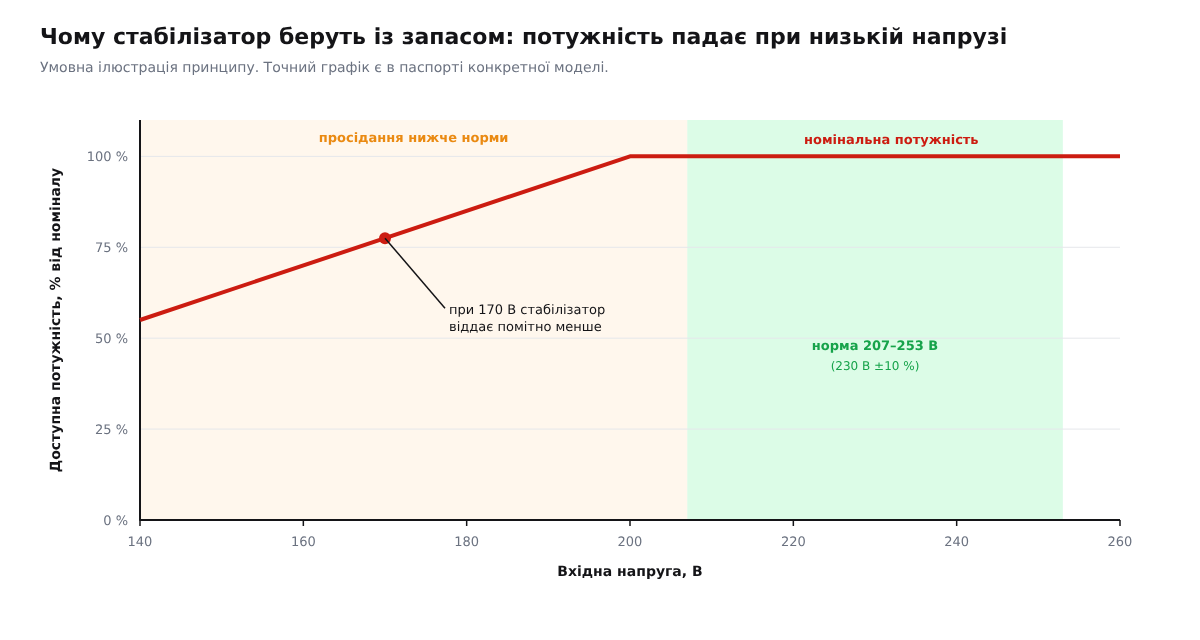
The graph is illustrative: every model has its own curve, and manufacturers give it in the datasheet as a graph or table. The conclusion is the same: if you have 170–180 V in the evenings, a stabiliser sized “exactly” for your load will not cope. Before buying, find in the datasheet how much the model delivers at your minimum voltage.
How to choose the power
| What to consider | How to calculate |
|---|---|
| Total power | Add up the power of the appliances that really run at the same time (from their datasheets) |
| Starting currents | A fridge, pump or air conditioner draws several times its rated power at start-up. Take this into account from the appliance datasheet |
| Power reduction at low voltage | See the graph in the stabiliser datasheet for your minimum input voltage |
| Margin | Electricians usually add 20–30% on top so that the stabiliser does not run at its limit and overheat |
| VA and W | If the power is given in volt-amperes, check the datasheet for the active power (W) the model delivers |
Why an inverter usually does not need a separate stabiliser
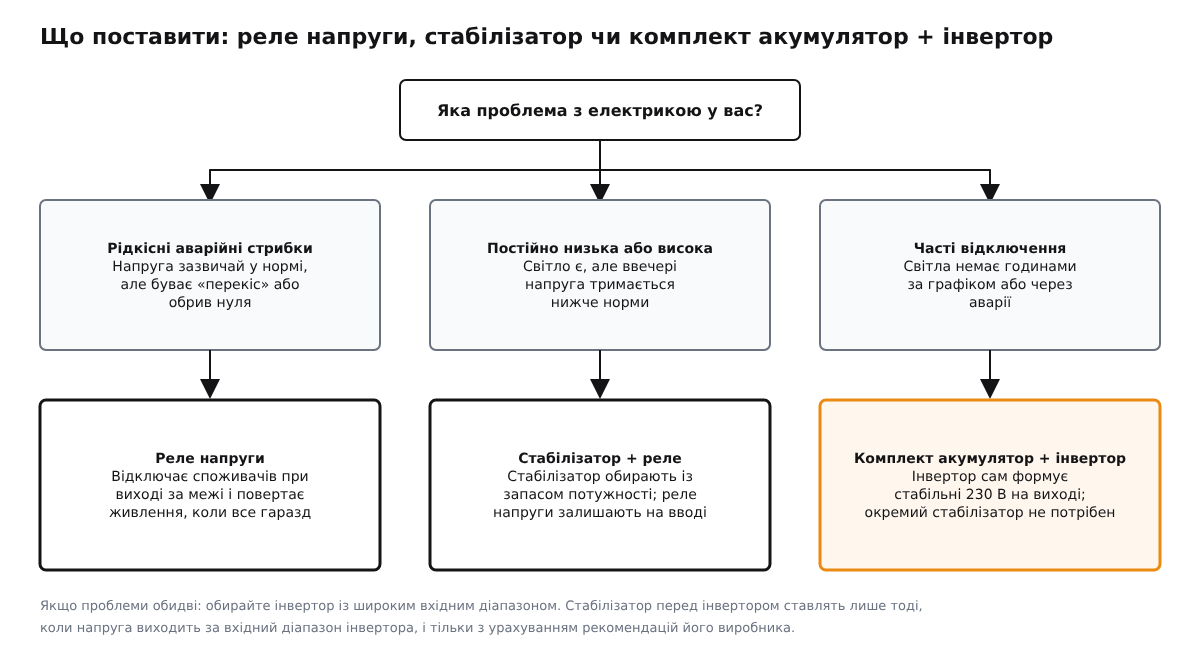
The inverter in a battery + inverter kit produces the 230 V output voltage itself. When the grid is normal, it passes it through to the output; when it goes outside its input range or disappears, the inverter switches to the battery and delivers a stable voltage. In other words, the backup group’s loads are already protected against both sags and outages.
A stabiliser in front of an inverter only makes sense when the grid voltage is almost always below the inverter’s input range and the battery discharges even when there is power. But even then, first check the inverter settings (many models have a wider input voltage mode for household appliances) and its manufacturer’s recommendations.
Typical mistakes
- Buying it “exactly to size”. A 5 kW stabiliser for a 5 kW load at 175 V in the evening will keep shutting down or overheating.
- Trusting the label on the housing. The rated power is not guaranteed across the whole input range. Look at the graph in the datasheet.
- Fitting a stabiliser instead of a voltage relay. It is the relay at the incoming supply that protects against a broken neutral and spikes outside the range.
- Fitting a stabiliser for the whole house when only the boiler and fridge need protecting. Sometimes a local stabiliser or a backup group from an inverter is cheaper and more effective.
- Installing a stabiliser in a damp or enclosed room without ventilation. It heats up and must stand where its manual says.
- Running a welding machine or powerful tools through a household stabiliser. Such loads need a separate calculation.
How to choose: step by step
- Measure the voltage. For a few days, write down the readings in the morning, in the evening and after the power comes back. A voltmeter in the board or a voltage relay with a display helps most.
- Identify the problem. Rare faults: a voltage relay. Constantly low or high voltage: a stabiliser. Frequent outages: a battery + inverter kit.
- Decide what to protect. The whole house or only important loads: the boiler, fridge, pump, electronics.
- Work out the power, taking into account starting currents and a 20–30% margin.
- Choose the type. To suit your budget and your requirements for speed, quietness and smoothness.
- Check the datasheet. Input range, power graph at low voltage, accuracy, bypass and protection.
- Connect it through the board. A separate breaker, a voltage relay at the incoming supply, earthing of the housing.
Safety first
A stabiliser for a whole house or apartment is connected in the board, and this is work at 230 V. Do it only with the incoming supply de-energised and after checking that there is no voltage. The connection must comply with the PUE: a breaker in front of the stabiliser matching its rated current, a cable of the right cross-section, earthing of the housing. If you have no experience, have the installation done by a qualified electrician.
Expert opinion
A stabiliser is a good tool, but not a universal answer to every electrical problem. Almost everyone needs a voltage relay, a stabiliser is for those whose voltage is regularly out of range, and with frequent outages a battery + inverter kit is the most useful: it both stabilises the voltage and keeps the lights on when the grid is down. If you do buy a stabiliser, buy one with a margin, and only after checking in the datasheet how much it delivers at your real evening voltage.
Not sure what you need, or want a turnkey installation in Dnipro? Call us: 093 293 93 93, 099 054 40 38. MinerTech engineers will help you understand your grid and find the right solution.