
12, 24 or 48 volts: which system voltage to choose for backup power
The first technical question we ask a customer before selecting a backup power system is: what power are we planning for? The answer determines the system voltage, that is, the voltage of the battery and inverter: 12, 24 or 48 volts. A mistake here means thick cables that heat up, a battery that cannot handle the load, or overpaying. Here we explain how voltage affects current, cable cross-section and equipment compatibility, and what to choose for an apartment or house.
Why system voltage matters so much
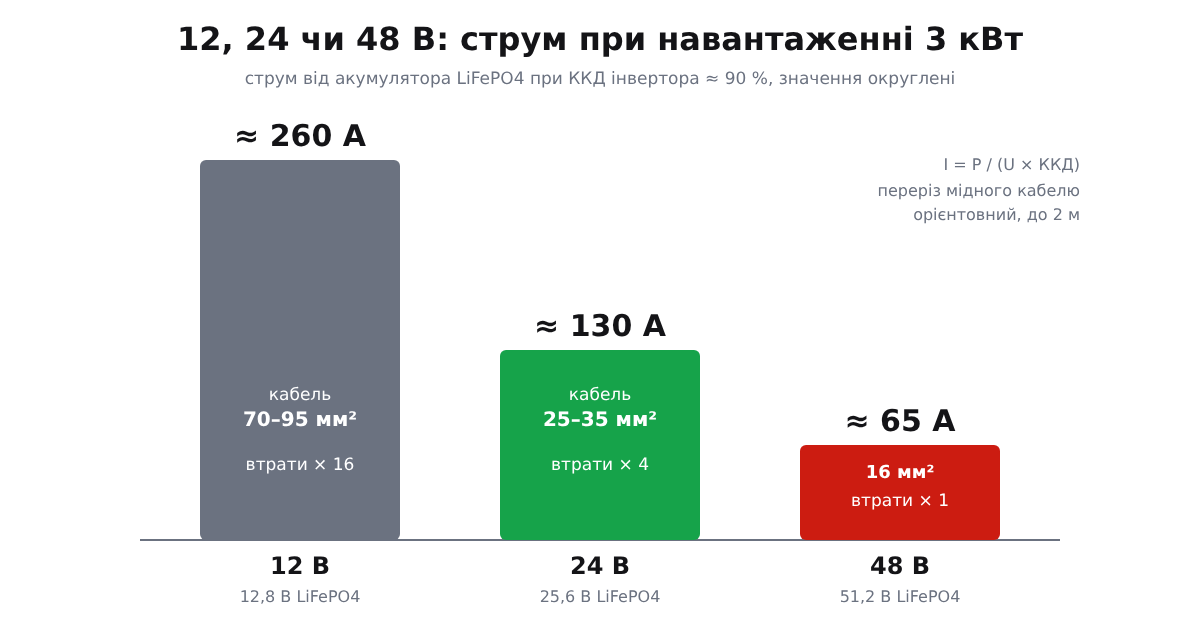
The inverter draws energy from the battery as direct current. Power equals voltage multiplied by current, so at the same power, the lower the voltage, the higher the current. Take a 3 kW load (a kettle or microwave together with a boiler and fridge). Allowing for an inverter efficiency of about 90%, the battery will need to supply approximately:
- 12 V (LiFePO4 12.8 V): about 260 A;
- 24 V (LiFePO4 25.6 V): about 130 A;
- 48 V (LiFePO4 51.2 V): about 65 A.
As the battery discharges, its voltage drops slightly and the current rises further. That is why a 3 kW load is not built on 12 V in practice: the BMS of a typical battery will not deliver such a current, and the cables would have to be like those of a welding machine.
Current, cable cross-section and losses
A high current requires a thick cable. As a guide, for a copper cable up to 2 m long between the battery and the inverter at 3 kW: 12 V needs 70–95 mm², 24 V needs 25–35 mm², and 16 mm² is enough at 48 V. We always take the exact cross-section from the inverter manual and take the length into account.
Losses matter even more. Heating of cables and contacts is proportional to the square of the current: with half the current, losses are four times lower. Moving from 12 to 48 V reduces losses in the same wires roughly 16 times. That means less heating of the terminals, less voltage drop and more energy reaching your appliances.
A high current also affects protection: the DC breaker or fuse between the battery and the inverter is chosen for the current, and at 12 V with several kilowatts it becomes very large and expensive. To connect the battery to the inverter, use ready-made cables with properly crimped lugs, for example the power cable set 2 m M8-M8, and the shorter, the better.
Inverter and battery compatibility
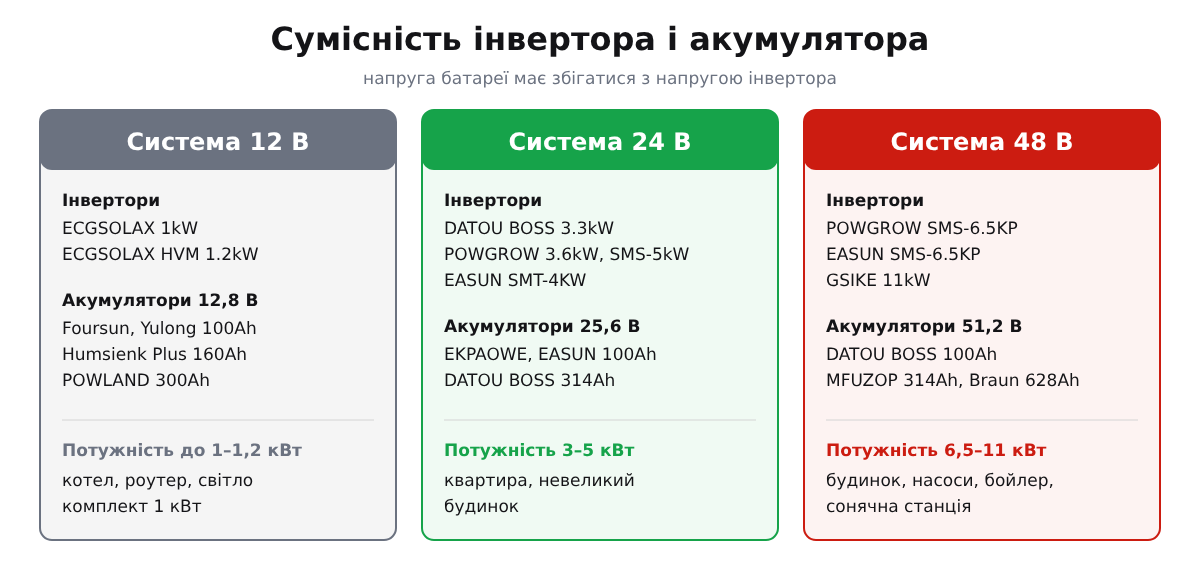
The main rule: the battery voltage must match the voltage the inverter is designed for. A 24 V inverter will not work with a 12.8 V battery, and a 51.2 V battery will damage a 24 V inverter. For LiFePO4 the correspondence is as follows:
| System | LiFePO4 battery | Typical power | Examples from the catalogue |
|---|---|---|---|
| 12 V | 12.8 V (4S) | up to 1–1.2 kW | ECGSOLAX 12V 1kW, ECGSOLAX HVM 1.2kW |
| 24 V | 25.6 V (8S) or 2 × 12.8 V in series | 3–5 kW | DATOU BOSS 3.3kW, POWGROW 3.6kW and SMS-5kW, EASUN SMT-4KW |
| 48 V | 51.2 V (16S) | 6.5–11 kW and more | POWGROW SMS-6.5KP, EASUN SMS-6.5KP, GSIKE 11kW |
The second rule: the power a battery can deliver continuously is limited by its BMS. A typical 12.8 V battery with a 100 A BMS gives about 1.2–1.3 kW, a 25.6 V 100 Ah one about 2.5 kW, and a 51.2 V 100 Ah one up to 5.1 kW. You can see that the same 100 A BMS gives four times more power at 48 V than at 12 V.
Examples of systems from our catalogue
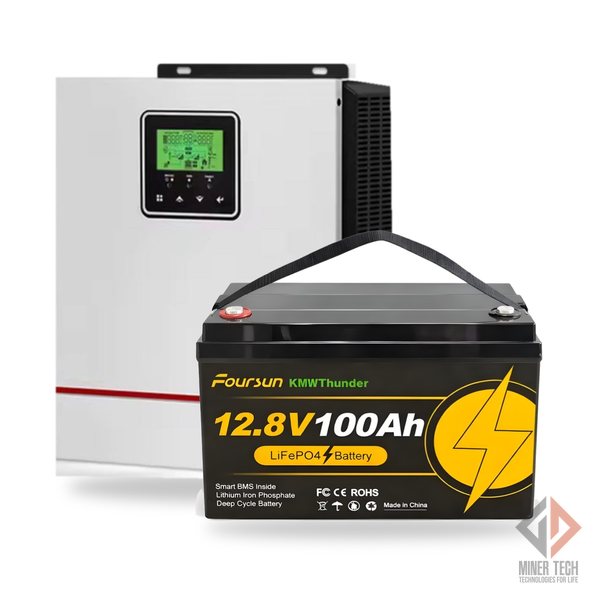
12 V: minimum backup. The 1 kW kit consists of an ECGSOLAX 12V 1kW inverter and a Foursun 12.8V 100Ah battery of 1.28 kWh. A usable reserve of about 1.04 kWh is enough for roughly 3.5 hours at 300 W (fridge, router, lighting). An option for a gas boiler, internet and lighting, without a kettle or microwave.
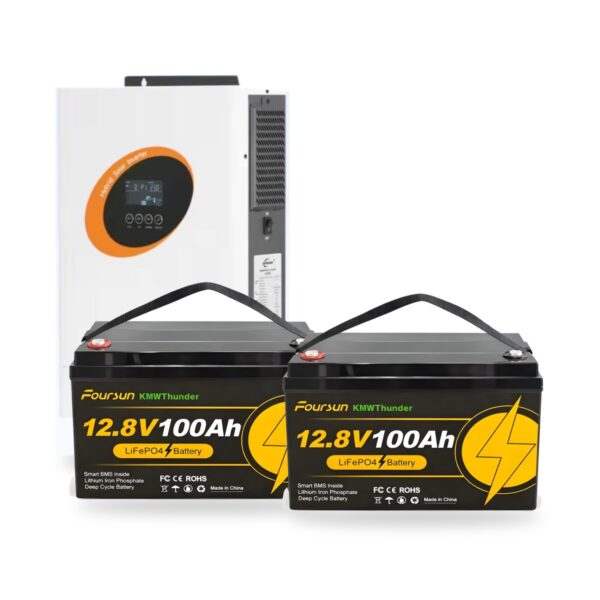
24 V: the sweet spot for an apartment. The POWGROW SMS-5kW 24V inverter delivers 5 kW rated and 10 kVA peak. To get 4–5 kW from the battery, it is paired with a battery with a 200 A BMS or two 25.6 V batteries in parallel. An interesting 24 V option is built from two 12-volt batteries: in the JSD 4kW + 2 × 12.8V 100Ah kit two Foursun batteries are connected in series and together give 25.6 V and 2.56 kWh.
48 V: a house and a solar station. The 6.5 kW POWGROW SMS-6.5KP 48V inverter paired with a 5.12 kWh DATOU BOSS 51.2V 100Ah battery gives a continuous load of up to 5 kW, and DATOU BOSS batteries can be expanded to 15 units in parallel. The inverter accepts up to 9,000 W of solar panels and supports parallel operation, including a three-phase system.
How to choose the voltage: a short rule
- Up to 1.2 kW (boiler, router, lighting, laptop): 12 V, the simplest and cheapest system.
- From 2 to 5 kW (apartment, small house, microwave, kettle): 24 V.
- From 5 kW, pumps, a water heater, an air conditioner, solar panels of several kilowatts: 48 V.
If you are torn between two options, choose the higher voltage: such a system is easier to expand, and the current headroom will remain for future appliances too. See ready-made pairs with verified compatibility in the battery + inverter kits section.
Important
Hundreds of amps of direct current do not forgive mistakes: a loose contact or a thin cable can melt the insulation. Always fit a DC breaker or fuse in the positive wire, tighten the terminals firmly and do not connect batteries in series if the manufacturer forbids it. The inverter is connected to the distribution board only by a qualified electrician.
Frequently asked questions
Can the system voltage be changed later?
No, not without replacing the inverter. That is why the voltage is chosen from the start, taking possible expansion into account, for example adding solar panels.
Can 24 V be built from two 12 V batteries?
Yes, if the batteries are identical and the manufacturer allows series connection. That is how the JSD 4kW kit with two Foursun batteries is built.
Is 48 V dangerous?
48 V DC is considered a relatively safe voltage in case of accidental contact, but the battery’s short-circuit current is very high, so installation is done by a specialist.
Why is 12 V still sold?
For a small load of up to 1 kW it is the simplest and most budget-friendly solution with one compact battery.
Expert opinion
In practice we rarely install 12 V in apartments: as soon as a customer wants to use a microwave or kettle during a power cut, a 12-volt system goes beyond its capabilities. For an apartment 24 V is optimal; for a private house we almost always recommend 48 V: thinner cables, lower losses, easy battery expansion and a full solar station. Our team of electronics engineers has delivered more than 1000 off-grid systems, we bring all equipment from Europe, and the warranty is 1 year. Inverters and batteries for all three voltages are in the Inverters and Batteries sections.
Not sure which voltage suits you? Call us, and we will calculate a system for your appliances and carry out turnkey installation in Dnipro and the region: 093 293 93 93, 099 054 40 38.