
Optimal orientation and tilt of solar panels through the seasons: exact figures for London
The same solar panels can produce a quarter less energy simply because they were installed “any old way”. Which way should the panels face, at what angle should they be tilted, and is it worth changing the angle in summer and winter? We have calculated everything for London (51.51° N) using data from the European PVGIS system and astronomical formulas, so that you can plan your station on figures rather than guesswork.
In short: the figures for London
| Parameter | Recommendation | What it gives |
|---|---|---|
| Direction (azimuth) | Due south; a deviation of up to 45° to the east or west is acceptable | At a 45° deviation the loss is only 5–8% |
| Tilt for fixed mounting | 35–40° (PVGIS optimum 40°) | ≈1023 kWh per year for every 1 kW of panels |
| Acceptable tilt range | 30–50° | A loss of no more than 2% from the maximum |
| Seasonal angles | Summer ≈37°, spring and autumn ≈52°, winter ≈67° | About 2% more per year compared with a fixed 40° |
| Rows on a flat roof | Gap ≈ 3.7 × the height of the panel’s top edge | Rows do not shade each other at noon even on 21 December |
How high the Sun rises over London
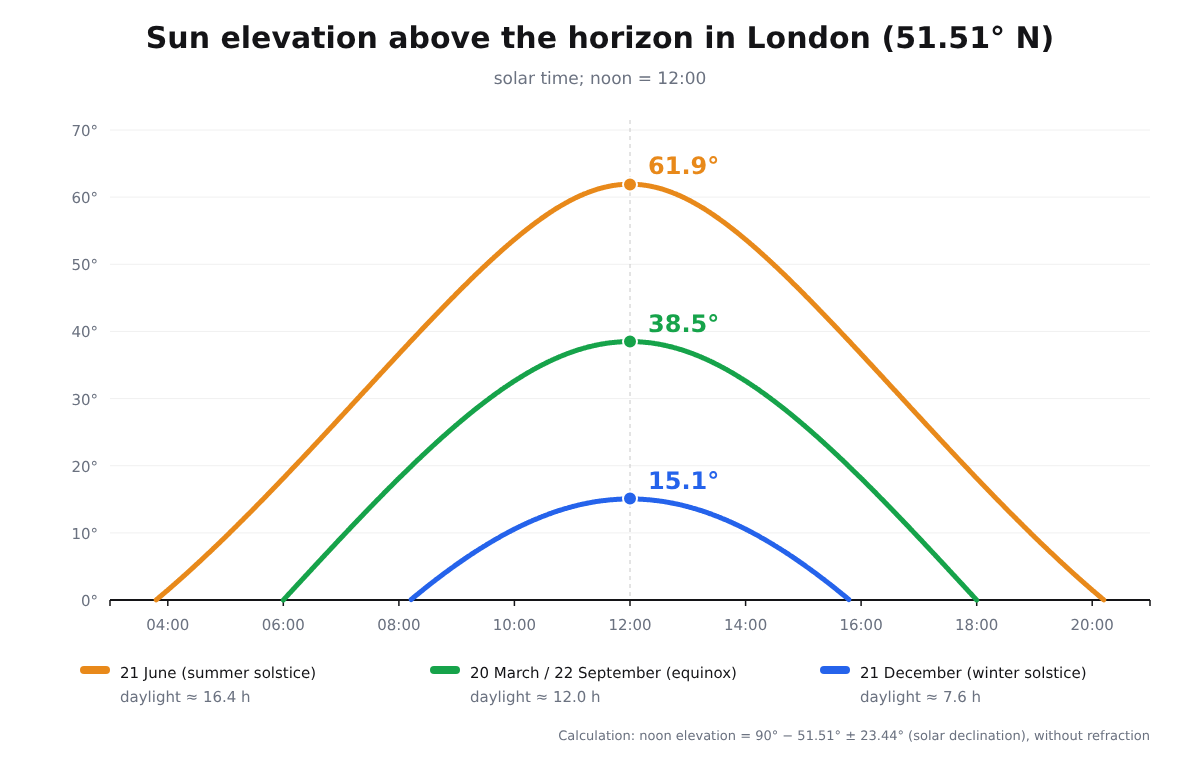
A panel gives its maximum when the sun’s rays hit it perpendicularly. And the Sun’s elevation above the horizon changes a lot over the year. At noon it is easy to calculate: 90° minus the latitude, plus or minus 23.44° (the tilt of the Earth’s axis).
- 21 June: the Sun is at 61.9° at noon, and daylight lasts about 16.4 hours.
- 20 March and 22 September: 38.5°, with day and night about 12 hours each.
- 21 December: only 15.1°, with about 7.6 hours of daylight.
Hence the main conclusion: in summer the Sun is high and panels are best set flatter, while in winter it is low, so the panels are better tilted more steeply.
The optimal angle for fixed mounting
Most stations are mounted once and for all, so the most important question is: which single angle gives the most energy over the whole year? We asked PVGIS (a service of the European Commission’s Joint Research Centre) for London’s coordinates. The answer: 40° facing south, with an annual yield of ≈1023 kWh per kilowatt of panel capacity, taking into account typical system losses of 14%.
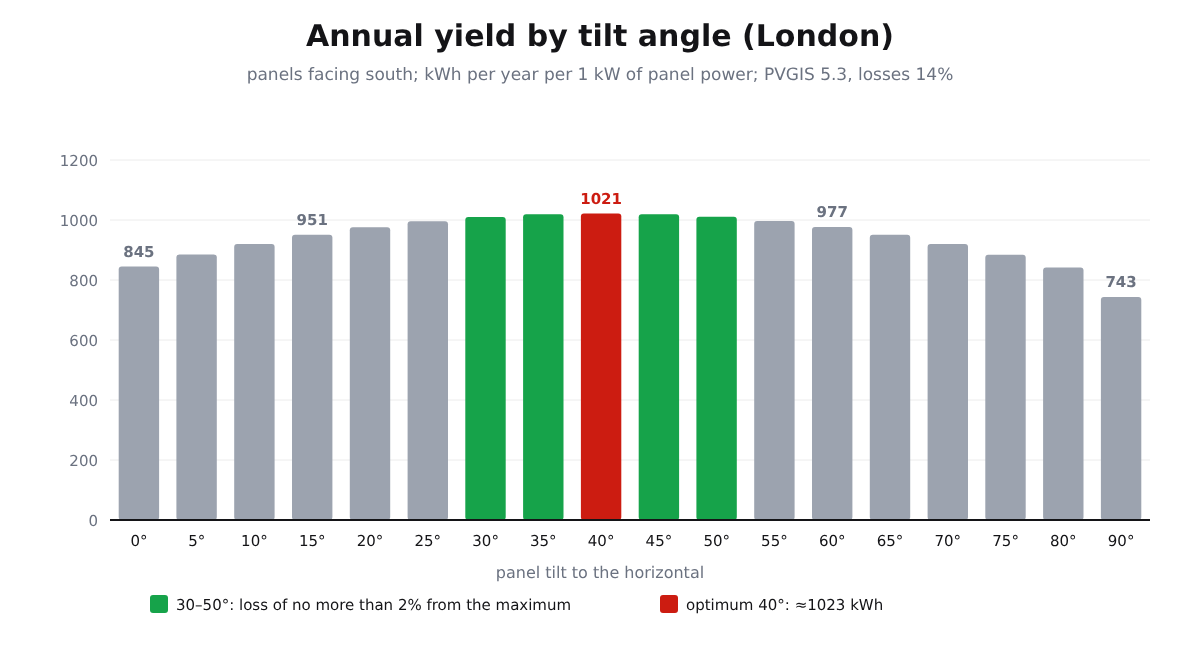
The good news: the top of this curve is very flat. Any angle from 30° to 50° loses no more than 2%. So if your roof pitch is 35° or 45°, mount the panels flush with the roof: the gain from extra brackets would be negligible. But the extremes are costly:
- panels laid horizontally (0°) give ≈845 kWh, i.e. 17% less, and are cleaned less well by rain;
- vertical mounting on a south wall (90°) gives ≈743 kWh, 27% less, but in winter it works almost as well as a tilted panel.
Tilt angles in different seasons
If the structure allows the tilt to be changed, use a simple rule: winter ≈ latitude + 15°, spring and autumn ≈ latitude, summer ≈ latitude − 15°. For London this is about 67°, 52° and 37°.
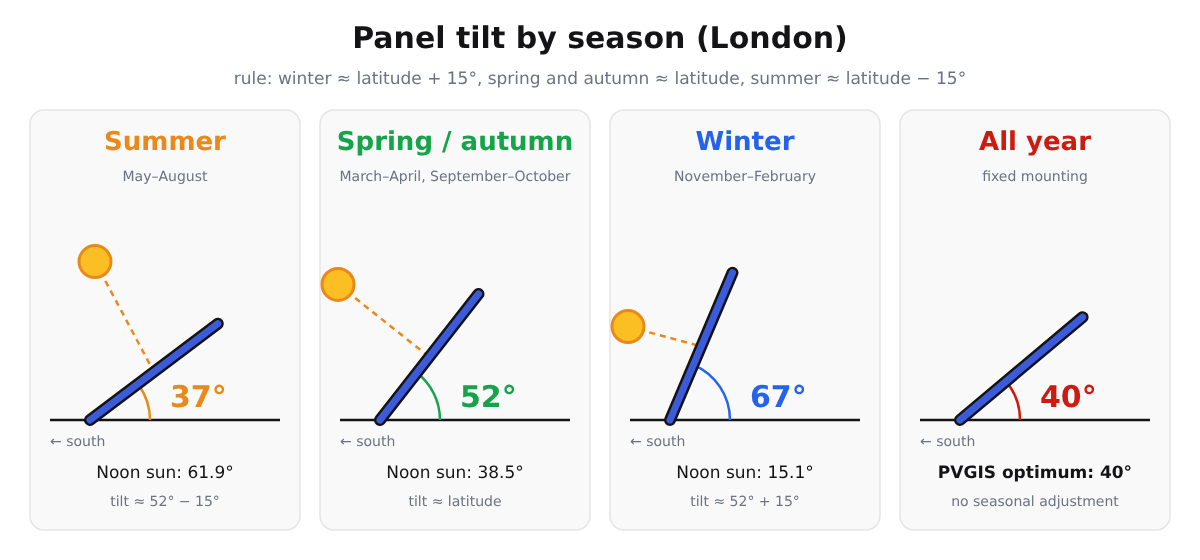
According to the PVGIS model, the best angle for each month in London is as follows (in 5° steps):
| Months | Best angle |
|---|---|
| November / December / January | 70° / 75° / 70° |
| February / October | 60° / 55° |
| March / September | 50° / 45° |
| April / August | 35° / 25° |
| May | 20° |
| June, July | 15° |
Is it worth readjusting? Let us count honestly. A fixed 40° gives ≈1023 kWh/kW per year. Three seasonal positions using the rule above (37°, 52°, 67°) give ≈1048 kWh, i.e. +2.4%. Two adjustments a year (25° from April to September and 60° from October to March) give +3.4%. Even changing the angle every month adds only +4.5%. For a 10 kW station that is 250–460 kWh a year.
Conclusion: on a pitched roof, readjusting pays back neither the adjustable mounts nor your time on the ladder. It makes sense for ground-mounted structures with easy adjustment and for off-grid systems where winter is what matters: then simply keep a steep 60–70° angle all year, because in December it gives about three times as much energy as a horizontal panel, and snow slides off a steep panel faster.
Direction: south, east or west
The ideal direction in the Northern Hemisphere is due south. But a roof is not always oriented that way, and that is not a disaster.
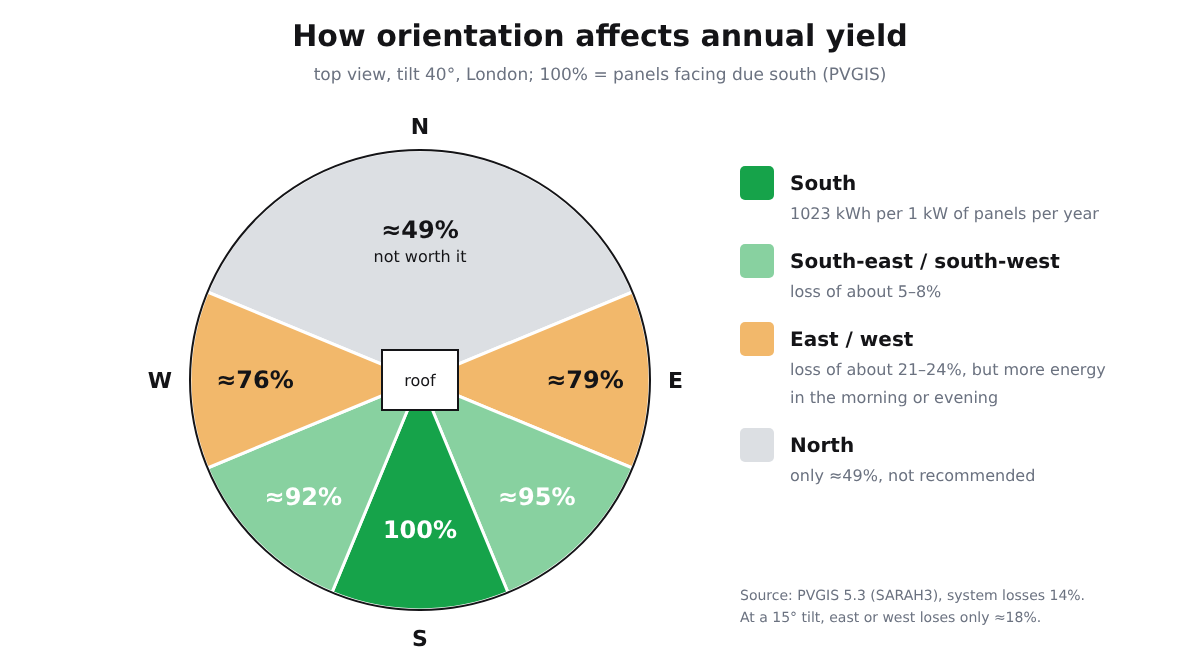
- South-east or south-west (a 45° deviation): ≈92–95% of the maximum.
- East or west at a 40° tilt: ≈76–79%. If you reduce the tilt to 15°, the loss shrinks to ≈18%. East and west are interesting because they give energy in the morning and evening, when many people are at home. A popular solution: half the panels facing east, half facing west, with a shallow tilt.
- North at a 40° tilt: only ≈49%. Such a roof slope is better left without panels.
A small tip: magnetic south on a compass differs slightly from geographic south, but a few degrees make practically no difference to the yield. It is more important to calibrate your smartphone compass and not to measure next to the roof’s metal structures.
Shade: the main enemy of yield
Even perfectly oriented panels lose a lot if shade falls on them. Panels in a string are connected in series, so the shadow of a chimney, an aerial or a branch on one panel reduces the current of the whole string.
- Check that nothing casts a shadow on the panels from 9:00 to 15:00, especially in winter, when shadows are long.
- Do not put panels next to growing trees: in a few years shade may appear where there was none.
- If part of the roof is inevitably shaded, put those panels in a separate string on a separate inverter MPPT input, or use optimisers.
Spacing between rows on a flat roof
On a flat roof or on the ground, panels are set in rows, and the front row must not shade the back one. The calculation is done for the worst day, 21 December, when the Sun rises to only 15.1° at noon.
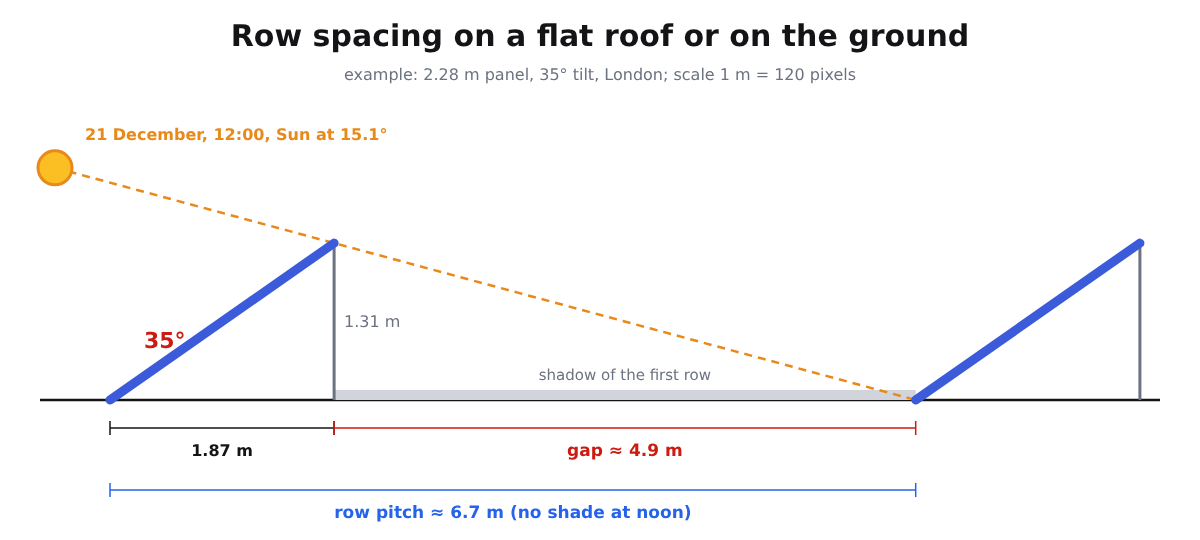
Formula: gap = height of the panel’s top edge ÷ tan 15.1° ≈ 3.72 × height. For a 2.28 m panel at 35°, the top edge rises 1.31 m, so the clear gap should be ≈4.9 m and the row pitch ≈6.7 m.
If space is tight, reduce the angle. At 20° the same panel rises only 0.78 m, the gap shrinks to ≈2.9 m and the pitch to ≈5.0 m. Each panel’s annual yield drops by only ≈5% (976 versus 1023 kWh/kW), but more rows fit on the same roof. For commercial flat roofs this is often more profitable.
How to plan it yourself: step by step
- Determine which way the roof slopes face. With a compass or on a satellite map. Priority: the south slope, then south-east and south-west, then east and west.
- Measure the roof angle. With a protractor or a smartphone app. If it is within 25–45°, mount the panels parallel to the roof.
- Check for shade. Look at the roof at 9:00, 12:00 and 15:00, and better still, take the winter Sun into account: it is low, and shadows are about 3.7 times longer than the height of the object.
- For a flat roof, choose the angle (35–40° for the most from each panel, 15–20° for the most from the roof area) and calculate the row pitch using the formula above.
- Check your address in PVGIS. The service is free: mark the point on the map and enter the power, angle and azimuth, and you will get a monthly yield forecast.
- Check the roof’s strength and wind load. Panels at a steep angle on a flat roof act like a sail, so the mounting and ballast are calculated separately.
Safety first
Work on the roof only with a safety harness and in pairs. Solar panels produce voltage in daylight even when the inverter is switched off, and a series string of panels can deliver hundreds of volts DC. Do not disconnect connectors under load, and have the connection to the inverter and board done by a qualified electrician.
Expert opinion
In practice, the biggest losses come not from 30° instead of 40°, but from shade and poor orientation. So first choose the best roof slope and get rid of shade, and only then think about degrees. For a grid-tied or hybrid station in London, the universal answer is simple: south, 35–45°, no seasonal readjustment. For an off-grid system that has to get through the winter, set the panels steeper, at 60–70°, and allow more headroom in panel power and battery capacity. Across 1000+ off-grid systems we have delivered, we have seen that it is precisely the winter balance that determines whether a system is truly independent.
Want an engineer to select the panels, angles and mounting for your roof, or need a turnkey installation in Dnipro? Call us: 093 293 93 93, 099 054 40 38. We bring the equipment from Europe and give a 1-year warranty on everything.